
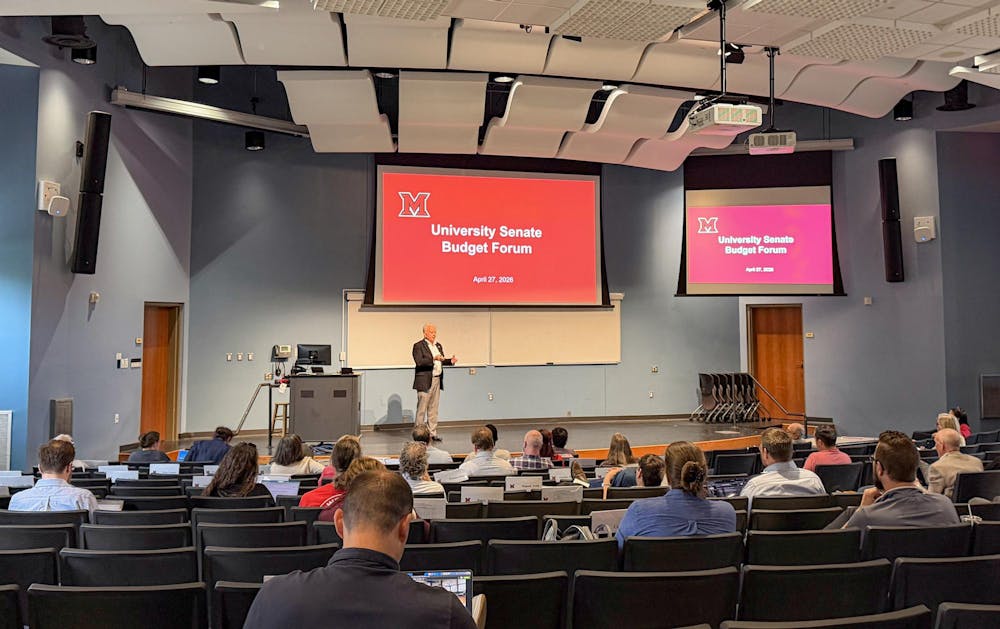
Miami University Senate outlined their short and long term financial trends, emphasizing challenges to come during their annual budget forum on Monday.
Nathan French, vice chair of senate and chair of the Senate Executive Committee, opened the meeting by introducing vice president for finance and business David Creamer and Provost Chris Makaroff, expressing appreciation for their work.
Creamer began by discussing the upward trend in net tuition revenue after the effects of COVID-19.
“We’ve started to make some progress,” Creamer said. “It’s better that we’ve been able to reverse the trend and see some positive patterns in the last couple years that we have not seen in a while.”
The improvements have come as a result of stronger recruitment efforts and reducing institutional funded scholarships. Although promising, Creamer cautioned that projections for the upcoming budget remain uncertain as the university finalizes enrollment numbers.
He said expenses may still go over projected revenue sources such as state support and tuition. Miami has attempted to close the gap by relying on investment income rather than surpluses from previous years.
Enjoy what you're reading?
Signup for our newsletter
“We’ve basically eliminated the operating surpluses, and we’ve increased the amount of investment income that we use to build the budget each year,” Creamer said. “The challenge with that is this is very bold.”
Creamer said Miami has adjusted its budget strategy in response to changing revenue sources, while also focusing on long term stability.
“When we’re thinking about the budget, we’re not just thinking about how to get through next year,” Creamer said. “We’re trying to anticipate what we need to do to manage these trends on a long term basis so the institution is able to accomplish its mission and maintain a strong financial situation.”
The university is seeing major changes in where students choose to enroll. In the last decade, there has been a growth in enrollment in flagship institutions while there is a decrease in enrollment at liberal arts and regional colleges across the nation.
Creamer said Miami falls between flagship universities and regional public colleges, meaning it falls in the middle of these trends.
He added the national enrollment patterns have changed significantly since the Great Recession, when student interest shifted to career-focused majors due to concern about return on investment. While high school graduate rates have remained stable, fewer students are enrolling in higher education altogether.
“Students have become much more career focused,” Creamer said. “They’re looking at earnings and the value proposition of a degree when deciding where to enroll and what to major in.”
Creamer added there is an expected decline in high school graduates by the end of the decade and into the early 2030s due to declining birth rates. He said Miami must respond by increasing competitiveness and adapting to the changes.
Makaroff spoke about the uneven distribution in interest and budget across majors. He said there has been a large surplus in some areas, specifically in STEM, while there are deficits in others.
He said this has forced Miami to shift funding and staffing toward the areas with higher student demand, “Departments where we know we’re not going to hire because the number of majors is going down —— we swept those lines. We took them off their books, so now the department actually looks healthy, rather than carrying this debt to make them look bad.”
He explained the changes will stabilize the university’s budget and create balance in the different majors.
The forum also addressed the university’s long-term strategies. They focused on investments in facilities, research and student experience.
Part of Miami’s strategy to expand their national profile is through partnerships and athletics, including the new basketball arena project, as it is a way to increase visibility and campus development.
Creamer added universities experiencing high enrollment have an emphasis on athletics, which the arena project is aiming to match.
“Either you grow into a national university or you die,” Creamer said. “You can’t stay the same.”
Creamer and Makaroff acknowledged concerns from the body, including how the project is being presented, too much focus on athletics and whether the cost of the stadium is justified. They stayed firm in the decision as a positive change for the university.
Miami is preparing for demographic challenges and financial pressures to remain. Creamer said higher education will continue to be more competitive, and emphasized the need to adapt to market conditions.
The University Senate will meet again at 3:30 p.m. Monday, May 4, in 111 Harrison Hall.
Read More


Private charity isn’t enough: The state is failing our children with cancer
By Jacob Van Riper | 7 hours ago"College students have to raise money for these causes because oftentimes, those in power do not help enough. These campaigns seek to spread awareness and raise money for people affected."
