
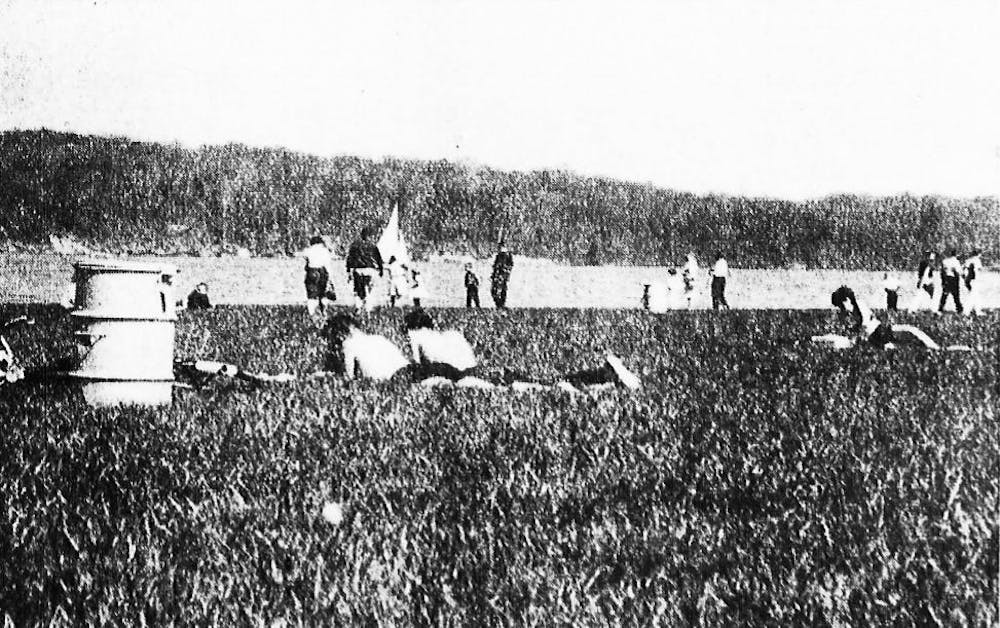
Two hundred years ago, Miami University looked very different from the red brick campus students now know it as. Trees covered campus that were used to heat dorms, and bobcats and river otters lived in abundance.
Steven Sullivan, director of the Hefner Museum, said that much has changed in Miami’s natural history since it opened in 1809.
“I think the wildlife that we can view can't really be overstated,” Sullivan said, “Just the number of species that people would have been familiar with and the number of species that they would have utilized in some way. These days, you go to Kroger and you're getting produce from usually just four or five species. Back then, we would have engaged with a lot more species and a lot more diversity.”
One species that Sullivan said many students frequently saw in Miami’s early days was the passenger pigeon, now completely extinct. At that time, passenger pigeons were abundant and would completely darken the sky for hours or even days. The last pigeon died in 1914 in the Cincinnati Zoo. These birds were hunted out of existence, as many people believed no amount of harm could eliminate them in their abundance.
The bobcat is another historic species that is currently returning to the Oxford area after displacement by human presence. Sullivan said people will not be able to see them with their own eyes, but camera traps have caught video of them roaming Miami’s natural areas.
The way students use natural materials in their everyday lives has also changed greatly. Olivia Herron, director of sustainability, said in Miami’s early days, each male student was issued an axe along with their school supplies. They were each expected to chop down trees to heat their rooms and cook their own food.
The designated woods for the students to cut down trees was where Armstrong Student Center, Shideler and Upham Hall currently stand.
“It was kind of up to you — do you want your room to be warm?” Herron said. “Then you sure better be cutting down trees, because if you don't, you're not gonna have heat.”
In 1979, Miami introduced a steam plant next to Peabody Hall that burned coal until 2016. It still operates today, but has since switched to run natural gas. The university also started its transition to geothermal energy. Elliott and Stoddard Halls, the first dorms constructed at Miami, were also the first dorms to be put on geothermal energy. Once more buildings transition to geothermal, the plant will be decommissioned.
These changes help to keep remnants of the old Miami campus alive to this day.
Steve Gordon, a 1975 Miami graduate and retiree, wrote a research paper on the history of Bishop Woods and its significance to old Miami. Gordon received his Master of arts in American History from the university in 1981. The woods are the last patch of forest that existed when Miami was founded. Until 1959, when the Bishop family left money for the gates to be built, the area was known as College Grove.
In the 1980s, Miami President Paul Pearson proposed the idea of protecting Miami’s natural beauty instead of destroying it for new construction. At the time, Bishop Woods was covered in invasive plants. The new goal was for Bishop Woods to maintain a balance of native plants and walking paths in the woods, as it is seen today.
Enjoy what you're reading?
Signup for our newsletter
Gordon said several botany professors used the semi-natural and walkable Bishop Woods as an outdoor learning lab for students to do taxonomy and study local plants. He also said that along with academic benefits, having natural areas around campus positively impacts mental health.
“There's numerous studies now which discuss [how] it elevates your endorphins,” Gordon said. “People feel better when they're getting fresh air — it's the sounds of the birds, the tranquility, and oftentimes being in the woods or outdoors [that makes] your blood pressure drop. I think even small spaces like Bishop Woods and other pocket areas, [like] the formal gardens of Dogwood Grove and Miami's Western campus, are all extremely important to overall health.”
To conserve these historical and beautiful natural areas, Sullivan said we must all look to the future and ask ourselves if we are leaving enough resources for people generations from now to engage with the campus the same way we do today. He also said that 200 years ago, humans did not use up as many of our resources as we do today, which is why the question of our future as a planet and human race looms so ominously in the distance –unless we do something about it.
“I would really encourage students to go out and try to recapitulate the experiences that your peers 200 years ago would have had,” Sullivan said. “Rather than driving somewhere, walking somewhere, or rather than buying pre-made meals, go buy some ingredients and chop them up. Try to engage with the world, both as a natural system and as consumers in the way that those people [did] 200 years ago.”
Read More

Water soluble confetti: A small change with big impacts
By Tori Fee | May 7, 2026In previous years, sidewalks around the seal, the Tri-Delt Sundial and the area under Upham Arch could be seen covered in plastic confetti following graduation photoshoots. This year, water soluble confetti has offered an alternative to plastic through a university-wide initiative.

North Chiller Geothermal project complete, next steps consider arena project
By Sarah Kennel | May 5, 2026Two years of construction on the North Geothermal Plant next to Millett Hall have come to a close. With big changes coming to North Campus in the form of a new arena and relocated intramural field, Miami's next steps in geothermal are taking this into account.

Earth Fest brings together local organizations under sunny skies
By Sarah Kennel | May 1, 2026Earth Fest brought out local organizations, small businesses and local advocacy groups to put on a day of celebration for the community. Activities fostered a local love and appreciation for the environment.