

COLUMN
On Feb. 27, the Miami University Board of Trustees approved a $242-281 million plan for a new Arena District in place of Cook Field. The approved plan will include a new arena for men’s and women’s basketball, a volleyball court and two auxiliary courts. This plan and its approval has been divisive, garnering support and opposition from students, alumni and fans.
The new Arena District, set to open in the fall of 2028, will be a great success for the students, athletes and local community.
Millett Hall will be 60 years old by the time it closes its doors after the 2028 season. The arena committee has estimated that renovations will cost $175 million dollars. The arena lighting is outdated and not built for basketball or volleyball. The ceiling and building do not enclose sound well, and the seats are far away from the court.
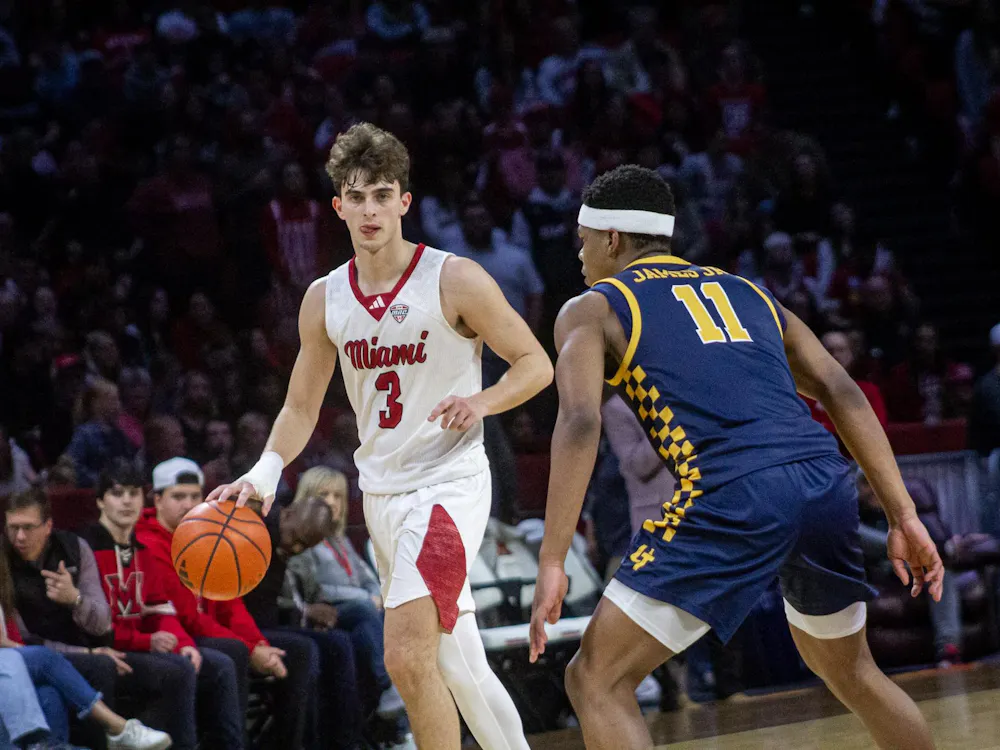
Another problem is attendance. It took a historical season from the men’s basketball team to sell out Millett consistently. The 9,200 seats in Millett are just too many for Miami athletic programs. Some of the best seats in the building are being used as hallways and tunnels, and large entry-ways are put in place of valuable seats close to the court.
One of the ways the new arena will help with attendance is location. Millett is far away from the majority of campus and student rental houses,a half a mile from the Farmer School or Business and one mile from South Quad dorms. An arena in the heart of campus would solve this problem. In the past weeks, the BCRTA bus system had to set up shuttles to get fans in the arena due to the long walks and winter weather. In comparison, the Cook Field site is centrally located, right next to Farmer and just under a half mile from South Quad.
Moreover, drivers have to traverse smaller, in-town roads that create immense traffic on game days to get to Millett Hall. Cook Field is right off of Highway 73, which is one of the main roadways into Oxford and Miami’s campus. Traffic will still exist, but it will be mostly on the outskirts of town, not log-jamming multiple blocks in northern Oxford.
Duke University’s Cameron Indoor Stadium only seats 9,300 people. The Blue Devils are arguably the biggest brand in college basketball and could easily sell 20,000 tickets a game. Yet, they’ve kept it smaller, mostly because of how close the seats are to the court.
Cameron Indoor is one of the hardest places to play in the country and has a great atmosphere. A 6,400-seat arena can be just as loud and intimidating as a 10,000 plus seat stadium with the right architecture and, of course, great fans.
Student-athletes would also benefit from the new arena. The experience of playing at a state-of-the-art new stadium would differ greatly from a 60-year-old auditorium that was transformed into a gym. The new arena would instantly become the newest and one of the best in the Mid-American Conference, if not the whole region.
In the highly-competitive world of the transfer portal and Name, Image and Likeness, Miami must win on the margins. The athletic department cannot afford $20 million basketball rosters, but athletes may take a discount to play in a brand-new facility.
The biggest benefactor of a new arena and surrounding district are the students of Miami. Cook Field is limited for intramural sports and student health. It is only a half grass, half turf area with a half-mile concrete path and two metal baseball backstops. The turf is old and needs to be updated, and the grass is poorly maintained and largely neglected.
Enjoy what you're reading?
Signup for our newsletter
The plan outlines immense progress to student athletic facilities on the old Millett site. Soccer fields, flag football fields, exercise equipment and walking paths are all planned to be built in place of Millett. Students will benefit from new green spaces just as much as the student-athletes will benefit from the new arena.
Economic opportunities will flood the region and the university, according to the university’s outline. The athletic teams playing in the new arena will have advantages over peers in terms of recruiting and retaining talent. Most importantly, students will have access to better facilities in place of the existing facilities at Cook Field. Building over Cook Field is not a perfect solution, but it is the best option to ensure the project is a success and appeals to students, athletes, and all of Southwest Ohio.
Read More

Miami Hockey adds new recruits thanks to rule chances
By Timmy Swearingen | 6 hours agoBefore last season, the National Collegiate Athletic Association (NCAA) made a landmark rule change that allowed hockey players who had previously played in the Canadian Hockey League (CHL) to play college hockey. Prior to the ruling, these players were seen as having lost their amateur status due to the CHL giving players stipends. The NCAA deemed them as professional payments.

Recap: Miami drops tough loss to Bowling Green, 24-20
By Pete Hartlage | 17 hours agoThe Miami University RedHawks (2-3) opened Mid-American Conference (MAC) play against the Bowling Green State University Falcons (1-4) on Oct. 3 at Yager Stadium.
Miami Men's basketball schedule review
By Jake O'Bruba | YesterdayThe Miami University men’s basketball schedule has officially been released. Coming off an undefeated regular season last year, the RedHawks look to replicate the success of a magical 2025-26 season.