
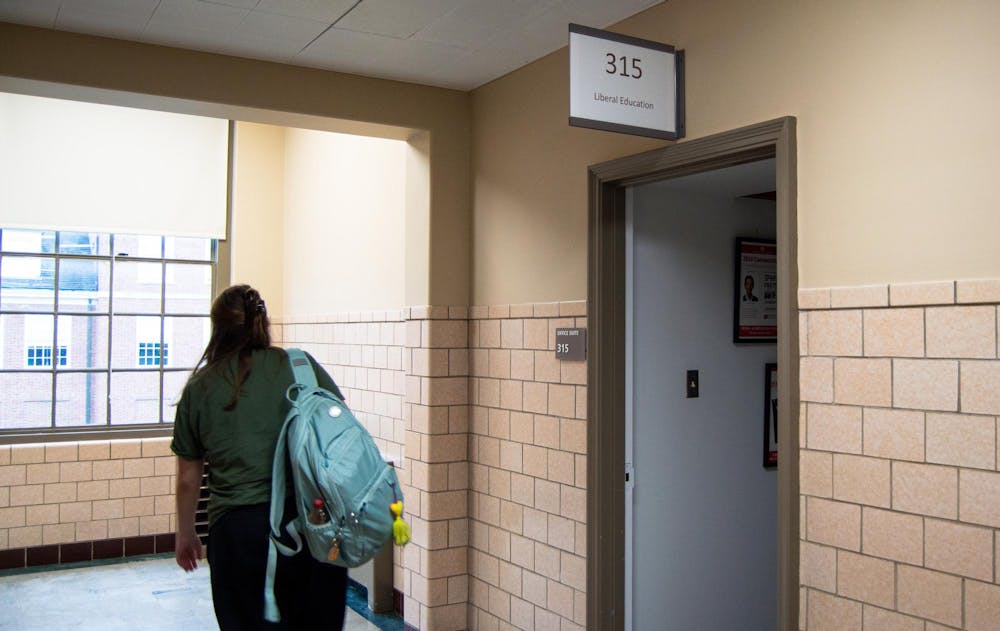
The Miami University Senate Miami Plan Revision Committee has proposed sweeping changes to the Miami Plan in response to a section in Senate Bill 1 (S.B. 1) requiring Ohio universities to teach an American civic literacy course to all students.
The revision committee is led by Elizabeth Wardle, the Roger and Joyce Howe Distinguished Professor of Written Communication and director of the Howe Center for Writing Excellence, and Marko Dumančić, associate provost for undergraduate education.
Wardle said she views the changes as an opportunity for the administration to consider how to integrate liberal education skills, such as writing and communication, into courses students are already taking.
“What we're trying to do is say, ‘What are the things we want students to learn? What do students want to learn? How can we make that as flexible and holistic as possible?’” Wardle said.
Current issues
Elizabeth Hoover, the interim director of liberal education, said one of the goals of the new Miami Plan is to shift faculty and students’ view of the curriculum from a set of requirements to be checked off to a more cohesive set of courses that a student can make cross-content connections with.
Enjoy what you're reading?
Signup for our newsletter
“If the value of the class is visible to students ... we think that students will be taking them because they're interested and they make sense to them,” Hoover said. “We want you to feel excited about what you're doing, and not like, ‘I gotta go check this off.’”
Nathan French, associate professor of religion and international studies, vice chair of University Senate and chair of the senate executive committee, said under the new Miami Plan, students with high credit hour majors will have more time and freedom to explore courses outside their major without having to worry about taking courses that count for a specific requirement.
Alexis Morter, a first-year nursing major, said she enjoys getting to take Miami Plan classes because they add more variety in her day and allow her to meet students she may not ordinarily get to interact with. However, she said her position as an honors student made scheduling more difficult, since honors students are required to take a certain number of honors courses.
“There's just not a lot of honors classes that fit into my schedule,” Morter said, “so I had a very limited selection of what I could choose from.”
Another important factor is the value of the Miami Plan classes. All students are required to complete the Miami Plan before they graduate, meaning a certain amount of their tuition goes toward these courses. Several of the Miami Plan courses also satisfy what is known as Ohio Transfer 36 (OT36), which is a set of state-mandated course requirements that all students in the state of Ohio must complete before graduating, including English composition, statistics, natural sciences and more.
For students in the 2025-2026 academic cohort, tuition costs $7,135 a semester, according to the Miami One Stop webpage. For a student taking 15 credit hours, that’s $475 per credit hour, meaning it costs $17,124 for a student to complete the required OT36 courses, not including additional charges for course materials like textbooks.
The current Miami Plan requires somewhere between 42-50 credit hours to complete, or between $19,979 and $23,785 in tuition. The revised version of the Miami Plan will be about 30-36 hours, or between $14,271 and $17,125, depending on whether certain OT36 requirements can be fulfilled by a student’s major or minor.
New plan
The new Miami Plan would eliminate the Global Citizenship and Signature Inquiry areas, which total 21 credit hours. The Knowledge in Action area will also be dissolved; however, the capstone course requirement will remain as its own, separate category.
The plan would add a civic literacy course worth three credit hours, as required by the recently passed S.B. 1. The new plan would also include an advanced writing requirement worth three credit hours and an applied skills requirement worth nine credit hours.
Hoover said it’s important to keep in mind that these changes won’t remove courses from the course catalogue, but will allow students more flexibility in their schedules.
“Just because a signature inquiry is not going to be a category or is not a proposed category in the new plan doesn't mean that that learning goes away, because it already is in a perspectives area that we're retaining,” Hoover said.
Another addition to the new Miami Plan is e-portfolios, which all students will be required to compile. An e-portfolio is a collection of work and projects that students engage in during their time at Miami and is meant to be a way to showcase work done across multiple classes.
Wardle said the idea for an e-portfolio is not new. Since she began teaching at Miami in 2017, the Howe Writing Center has offered workshops for building an e-portfolio, and many departments and divisions already use them, like the College of Creative Arts.
Although changes in the Miami Plan will not stop courses from being taught, it is possible that professors’ course loads and course offerings may be affected.
Implementation
French addressed the Board of Trustees at the Feb. 27 meeting and provided updates on the work of the Miami Plan Revision Committee. He also discussed a desire for more support for Miami’s Office of Liberal Education, which oversees the Miami Plan. The office currently has two employees: Hoover, the interim director, and Dorothy Falke, the administrative assistant.
“Our Liberal Education Council noted its support for the ongoing work of the Miami Plan revision committee and recommended those revisions for consideration by the University Senate, while underscoring to us the need for a well-resourced and staffed office for the administration of the revised plan,” French said in his address on Feb. 27.
The committee plans to implement the new plan beginning in the fall of 2027. This timeline is designed to be compliant with Ohio legislation requiring all students who graduate in the spring semester of the 2029-2030 academic year to complete the new American civic literacy course.
Read More

‘We’re two-time champions now’: Miami women’s basketball captures MAC championship to solidify spot in March Madness
By Kethan Babu and Cooper Meneghetti | 20 hours agoMiami women's basketball captured its second MAC championship in program history with a win over Toledo at Rocket Mortgage Arena

What to know about the 10 Associated Student Government body president and vice president candidates
By Liam Clarke | YesterdayThe Associated Student Government (ASG) president and vice president elections begin Monday, March 16. Here’s what to know about each ticket on the ballot after the March 10 debate.

Shannon Mahoney elected next editor-in-chief of The Miami Student
By Molly Fahy | YesterdayIn the crowded newsroom, located on the third floor of Armstrong Student Center, Shannon Mahoney, a sophomore strategic communication and creative writing major, was elected to be the next editor-in-chief of The Miami Student on March 8.