
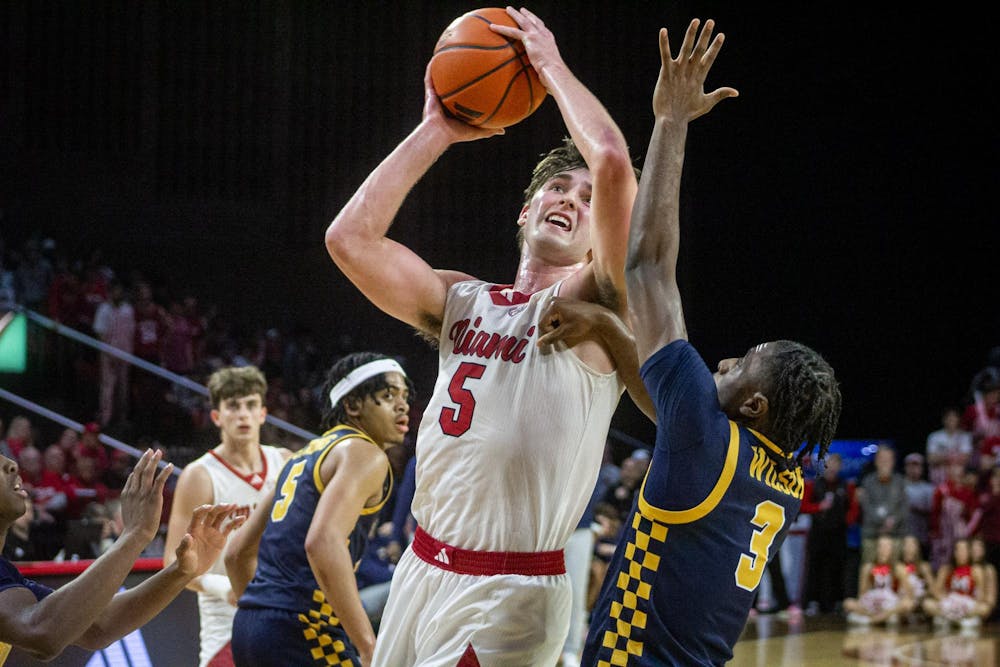
It’s no secret that the No. 20-ranked Miami University men’s basketball team is gaining momentum on campus and across the nation. After a relentless and admirable social media campaign by student basketball junkies and Barstool RedHawks, justice was finally served on Jan. 19.
The team was ranked 25th in the country by the AP poll — its first national ranking since the 1998-99 season during the days of star Miami player Wally Szczerbiak.
Since January, the men’s basketball team has reeled off 12 straight wins, and students have taken notice. In the Battle of the Bricks game, a sellout crowd of 10,640 attendees watched in jubilation as the RedHawks prevailed over the Ohio University Bobcats in a decisive 90-74 thumping of their archrival.
The record attendance at men’s and women’s basketball games this season reveals the obvious solution to Miami’s long-standing attendance problem: win and play games that matter.
I don’t mean to suggest that simply winning or developing athletic schedules is easy, of course. I played several sports in high school; we didn’t always get to play against whom we wanted, and victory was often out of reach. Although success is not always guaranteed, what can be assured is a schedule of intermittent games against teams about which students care, are surefire triumphs, or both.
The men’s basketball team exemplifies the “win some games” portion of my strategy. Its strength of schedule, according to the Cincinnati Enquirer, is 350th in the nation, which, in other words, is abysmal.
The easy schedule doesn’t come without benefits. Would Millett Hall really be selling out consistently if Miami weren’t undefeated, ranked No. 20 and receiving coverage from ESPN, Barstool and CBS Sports? I’m not saying we need to schedule the local intramural squad six weeks in a row to start every season, but a few games against teams like the University of Maine, University of Mercyhurst or University of Arkansas at Pine Bluffs wouldn't hurt.
Miami football could also benefit from a dose of the medicine I’m suggesting. Though, in their case, proximity and level of intrigue are likely more important than simply winning. The Battle for the Victory Bell against the University of Cincinnati Bearcats, Miami’s oldest rivalry, is a case in point.
I don’t have all the details about what led to the suspension of future games against the Bearcats (rumors of money and TV revenue abound). What I do know is that if football attendance is any sort of priority for Miami’s athletic department, then we should bend over backwards to get UC in Yager Stadium to battle for the Bell. Even if Cincinnati refuses to play us at Yager every other year, surely we can come to some compromise.
Maybe once every four years we play in Oxford with two of the other three being in Nippert Stadium and the fourth being in TQL or Paycor Stadium in downtown Cincinnati. If the goal is engagement and a sports-loving culture, then Miami cannot let the nation’s oldest non-conference rivalry disappear without a fight.
On the subject of football, another great example of how to get students engaged was demonstrated in the fall when Miami played the University of Nevada at Las Vegas (UNLV). “OxVegas vs Las Vegas" was the talk of the town during Rebel hate week. Playing UNLV intrigued students because it was at the beginning of the season and Vegas was a new face.
Solid home-and-home series against noteworthy Group of Six universities, like Las Vegas, provide new and intriguing matchups for RedHawks fans to enjoy. I commend the athletic department for its scheduling of an upcoming series against the University of Connecticut, a game that I hope will garner similar public attention.
Enjoy what you're reading?
Signup for our newsletter
Much of this editorial has probably sounded like unsolicited advice to the athletic department. President Crawford and his advisors have often lamented low student attendance, and to their credit, they’ve tried nearly everything to fix it: free T-shirts, bucket hats, cowbells, the occasional stack of cash and now a new multipurpose arena.
But if maximizing attendance is truly the goal, no giveaway — and certainly no new arena — will fill the stands the way rivalry games against regional teams and the occasional national ranking will. Students don’t show up for facilities. They show up for stakes.
It’s about building the program with the stadium already in existence. Students will attend — amenities or not — if given a matchup worth cheering for.
Aiden Bryant is a junior majoring in biology with a co-major in premedical studies. He serves as Speaker Pro Tempore of the Associated Student Government and works as an undergraduate research assistant in the Fisk Ecology Lab.
Read More

Canvas shuts down leaving students in limbo
By Shannon Mahoney | 3 hours agoCanvas, a learning management system widely used in high schools and universities across the U.S., went offline around 4:50 p.m. following an attack from a hacker group claiming to have compromised identifying information of 275 million people across 9,000 institutions. ShinyHunters, the hacker group, said it would release intelligence May 12 at midnight unless Instructure, Canvas’ parent company, pays a ransom.

‘Bittersweet’: The hardships of Black students at Miami University
By Layla Norris | 4 hours agoOn Wednesday, April 29, people gathered in a Shideler Hall lecture room to watch “Bittersweet: Black College Life at a Predominately White Institution.”

Meet the Columnist: Kathryn Hippe
By Kathryn Hippe | 4 hours ago"I walked into the newsroom expecting a sea of buzzing journalists, hunched over grammatical errors and looming deadlines. What I found instead were students compelled to question, challenge, reveal and urge others willing to listen."