
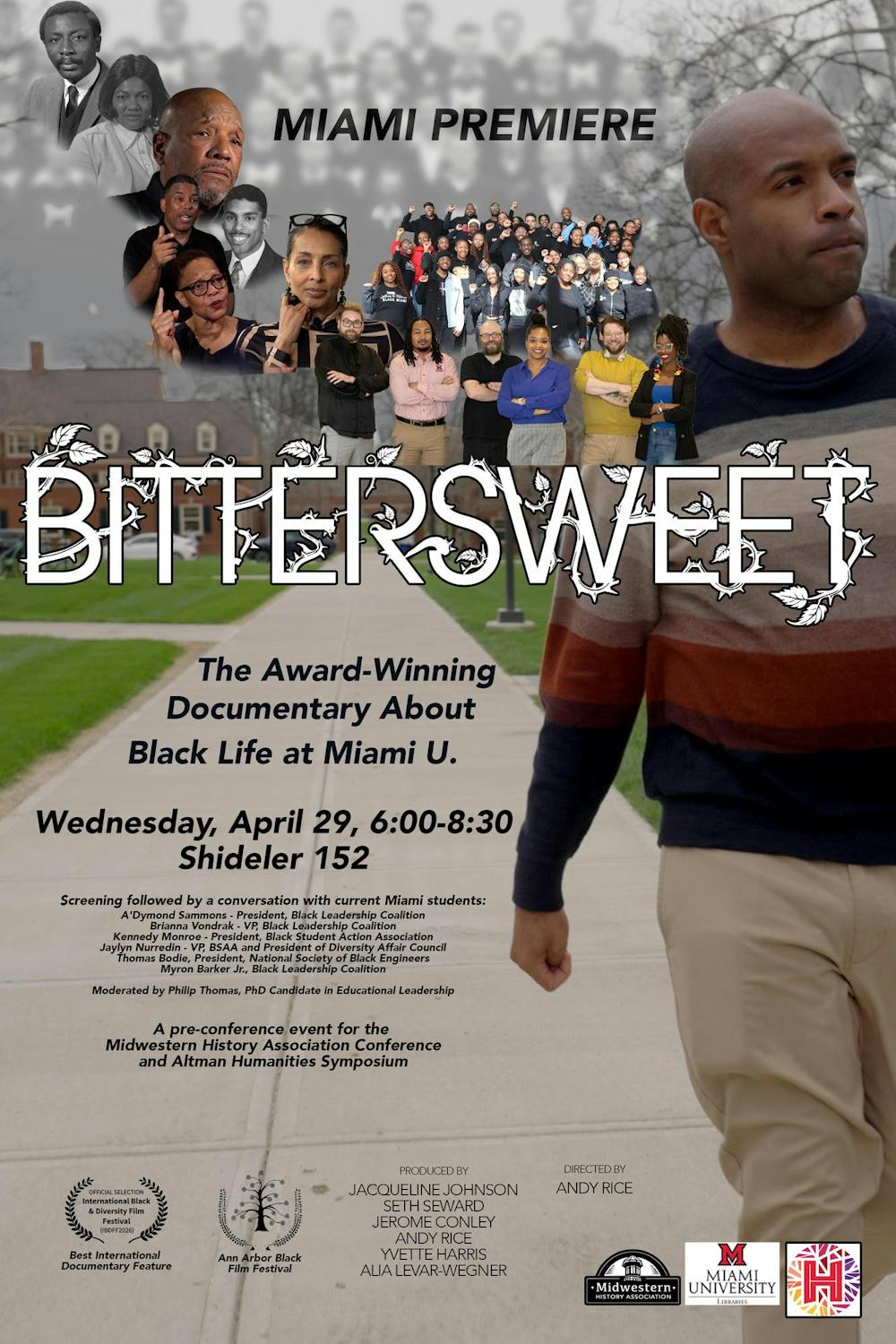
On Wednesday, April 29, people gathered in a Shideler Hall lecture room to watch “Bittersweet: Black College Life at a Predominately White Institution.”
In a runtime under two hours, this documentary follows the history of Black students at Miami University. It showcases their hardships and their triumphs alike. Speaking to students and faculty from the present day to the 1950s, viewers get a first-hand account of the Black experience at a predominantly white school.
Andy Rice, an associate professor of media, journalism and film at Miami, directed this project.
“This was part of a boldly creative project after the killing of George Floyd in Minneapolis, Minnesota, by a police officer,” Rice said. “Miami faced some student pressure, and for a brief time, they had funding available for projects about race and diversity on campus.”
Rice, along with others involved in the project, started creating the documentary in response.
“All of the interviews I did, these oral history interviews, were [Black] people talking to us about their lives here,” Rice said. “People that were here back in the ’50s, ’60s, ’70s and ’80s, like every decade.”
A large portion of the film focused on the history of the Black student experience at Miami. The Black Student Action Association (BSAA), began in 1968 as a response to the Civil Rights Movement and the Vietnam War. This organization is still active on campus today.
In 1970, Miami students took over Rowan Hall, the former ROTC building, in protest against the war. The BSAA was at the forefront of this movement.
Their president at the time, Larry Clark, helped lead the protest. In the documentary, Clark talks about a “flush-in” he helped orchestrate on campus. He urged all students who opposed the war to flush their toilets at 6 p.m. on the same day. In doing so, they drained the water reservoirs in Oxford.
Seth Seward, the assistant director of alumni relations, helped produce the film alongside Rice.
“It meant a lot to me to document the history of Black Miamians, the whole experience, the joy and community,” Rice said, “but also the bittersweet and things people went through that were painful. I’m glad the story was told.”
The film continued to document the actions of BSAA and the struggles for diversity Miami faced. The president of BSAA in 2022 was featured in the film and shared that the university consistently fails at making adequate efforts to recruit diversity within a predominantly white institution.
Enjoy what you're reading?
Signup for our newsletter
The university has made efforts to diversify the experience. In the ’90s, construction increased and funding grew. Black faculty and students were recruited, but campus diversity remained low.
In 2025, Ohio Governor Mike DeWine passed Senate Bill 1, or the “Advance Ohio Higher Education Act.” This bill placed restrictions on diversity, equity and inclusion initiatives in colleges all over the state. The law effectively closed Miami’s Center for Student Diversity and Inclusion (CSDI).
The film portrayed the work the office did and its impact on minority students on campus.
After the film, a panel of six Black students currently enrolled at Miami answered questions and spoke about their own experiences. All of them discussed the positive impact the CSDI had on their education and life. Without it, they are working harder than ever to promote diversity and inclusion on campus.
Brianna Vondrak, a third-year computer science major and an intern at the previous CSDI office, acted as one of the panelists. She agreed that the Black experience at Miami is bittersweet. She knows work must be put in to create space and diversity for Black students.
“We need to lean on each other and continue to advocate for ourselves because we are the only ones who know this experience,” Vondrak said.
Read More

Recap: Miami drops tough loss to Bowling Green, 24-20
By Pete Hartlage | 3244 minutes agoThe Miami University RedHawks (2-3) opened Mid-American Conference (MAC) play against the Bowling Green State University Falcons (1-4) on Oct. 3 at Yager Stadium.
Miami Men's basketball schedule review
By Jake O'Bruba | 14 hours agoThe Miami University men’s basketball schedule has officially been released. Coming off an undefeated regular season last year, the RedHawks look to replicate the success of a magical 2025-26 season.

The most radical thing college can do is change your mind
By Vedika Kaushal | 16 hours ago"I am not leaving every discussion with a completely different set of beliefs. Instead, I am becoming more aware of why I hold the views I do, especially when someone gives me a reason to question them."