

In 1809, the Ohio Legislature granted Oxford township a land grant to establish Miami University on a six-mile by six-mile plot of land, or 23,040 acres.
“Ohio University and Miami University were the prototypes of the land-grant supported state universities,” wrote American historian Fredrick Rudolph in his 1962 book, “The American College and University: A History.”
Yet, Miami University does not identify itself as a land-grant institution because the lands Miami received were acquired before the Morrill Act of 1862, which established the creation of 57 American colleges and universities.
Michael Banerjee, a graduate of Harvard Law School and current Ph.D candidate in jurisprudence and social policy at the University of California, Berkley, is conducting a study on this unacknowledgement of history.
“The Morrill Act of 1862 and the many land grants that came before were mainly designed to generate funds through [the] sale or lease of land,” Banerjee said. “The funds could then be put in a permanent endowment. Great institutions can tell the truth about themselves.”
Naturally, the centuries-old history of vast lands can be confusing, but land grants offer clues to better understand the past.
Enjoy what you're reading?
Signup for our newsletter
Cameron Shriver, a professor of colonial and native history at Miami, said the early ambitions of establishing universities like Miami were not solely altruistic, and the land grants given to them come with complicated histories of their own.
“The land was conquered from tribal nations by the U.S. federal government, and flipped for the purposes of not educating their children, but the children of settlers,” Shriver said. “The colleges were told to make money and expand American settlement westward.”
These public lands would go on to create an odd distinction that has become part of Miami’s identity as a “public ivy,” and a much more contemporary understanding of what it means to be a public or private university.
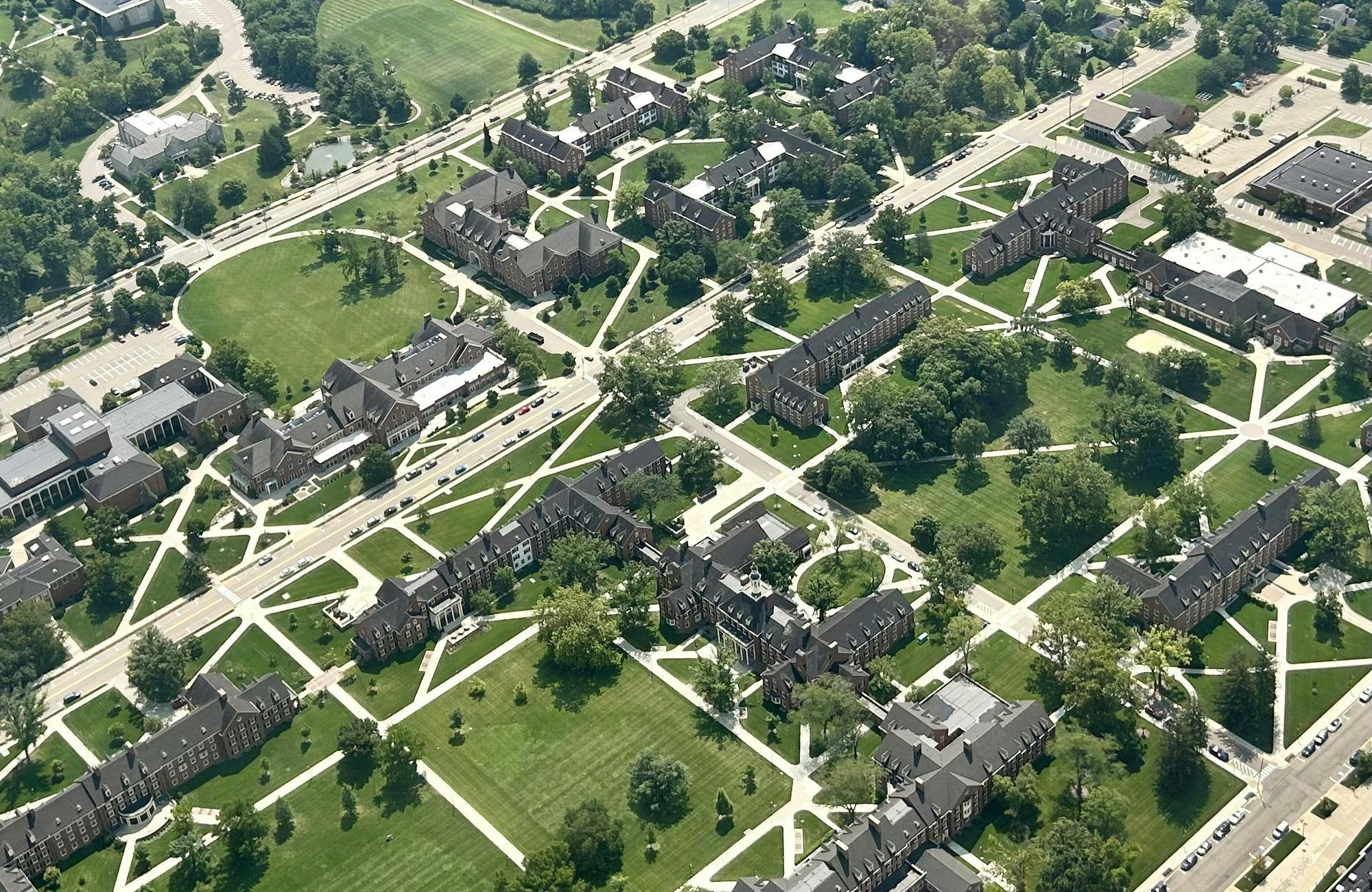
“There’s no such thing as a private university; They all received quite a bit of land from public authorities,” Banerjee said. “A private university is funded privately. I don’t think history supports that."
Many private universities benefited from land grants and other public resources, especially those that were founded under the Morrill Act of 1862 and the Morrill Act of 1890, which granted federal lands, often taken from Native American tribes, to state governments for the establishment of higher education institutions, and later, historically Black colleges and universities (HBCUs).
Banerjee said that rather than argue about our differences, there is an opportunity for a productive conversation to be had, which requires rethinking our perception of what it means to be a public university.
“The public-private university distinction is a fixture in our collective legal imaginations,” Banerjee said. “We’ve got to separate issues of control from issues of funding. Binding universities together, whenever possible, is all to the good.”
Regardless of Miami’s common perception as a “public ivy,” the mission of the student body is public, per its designation as a public university, and that is true of private universities, as well. Despite minute variations in funding technicalities and sourcing, all college students belong to the same line of history, Banjeree said.
The origins of universities can be traced back to the Middle Ages. During this little-understood era, there were three primary facilitators of society: the “sacerdotium,” or the clergy; the “regnum,” or the royalty; and the “studium,” or the university. That profound importance carries on into the present day.
“The university is one of the governing pillars of society,” Banerjee said. “The university that students study at has always been the object of favor and solicitude on behalf of public authorities.”
According to Banerjee, public beneficence is a privilege and obligates a firm sense of responsibility to inspire and create a better world.
“Students at universities like Miami might see opportunities to embrace an outward-looking, service-oriented ethos, owing a duty to the public or to the people whose land it once was,” Banerjee said.
A commitment by Miami’s administration can be seen in the formation of the Myaamia Center in 2001, and formal relations with the Miami Tribe of Oklahoma, which date back to 1972 when Chief Forest Olds visited campus.
“If nobody knew any of the history, Miami would still have a relationship with the Miami Tribe of Oklahoma, the Shawnee Tribe and the Wyandotte Tribe,” Shriver said.
Denis Alexa, a presidential fellow from Romania majoring in theater, said he believes an understanding of the history of Miami could provide insights into our daily life.
“I feel as though we need to understand the history of the land we are on, [in order] to honor the experiences that shape the cultural context in which we live in,” Alexa said.
Read More

An unexpected contributor: How AI is shaping class projects
By Shannon Mahoney | YesterdayA survey, conducted by a team of Miami University professors, showed 92% 0f student respondents reported having used generative Artificial Intelligence (AI), and 88% reported using it for academic work.
Sports is losing its magic
By Abe Hagood | Yesterday"Trump won’t be the last to intervene, but he misses the fact that the power of sports comes from its uncontrollability. Sports only work because they exist independently of the rational world."

My dorm experience as an ambulatory wheelchair user
By Whitney Wilson-Harris | 2 days ago"So, as the spring semester progressed, I found myself packing to move into my 'home away from home.'"