
From the first print issue of The Miami Student 200 years ago to today’s ever-accelerating technology-driven landscape, the media has consistently demanded our attention. To explain its full evolution would require a substantial encyclopedia — thousands of pages cataloging inventions, platforms and formats now taken for granted. Yet to understand the media, it isn’t necessary to recount its entire history. At its core, media reflects a persistent human impulse: the need to create, to record and to communicate.
When The Student published its first issue, the media existed largely on paper. Newspapers and popular novels were fixed objects, encountered weekly or daily; Their contents were confined to the page. The media did not move. This stillness gave the words more importance. Without the constant assault of images, words occupied the center of cultural life, shaping how information was absorbed and how stories were told.
Yet, storytelling would later be forced to evolve. At the turn of the 20th century, film emerged as a medium defined by motion. Where print demanded imagination, film offered sensation, drawing audiences into a world experienced viscerally rather than interpreted quietly.
Early cinema consisted of silent images accompanied by physical performers like Charlie Chaplin and Buster Keaton, whose bodies carried meaning in the absence of sound. With the arrival of “talkies,” motion pictures became a new medium altogether — the convergence of performance, music, image and language. Because of this, storytelling was no longer simply told; it was felt.
Cinema, therefore, gave birth to a newfound monoculture: A shared experience in a shared space. Movie theaters — these odd, dark places in which people come together — transformed media into an eventful spectacle.
A testament to cinema’s permanence is the classics of Old Hollywood that have become cultural landmarks in their own right. Films like “The Wizard of Oz” and “The Sound of Music” have been ingrained into the minds of Americans for so long that it almost feels as if we’re all born having seen them already.
Others like “Singin’ in the Rain” and “Roman Holiday” are the perfect examples of what constitutes Old Hollywood. That is, larger-than-life stories — fantasy worlds that exhibit a kind of exuberant joy.
Within the history of movies, however, lies a deep melancholy rooted in constant change.
Cinema has always shown an aptitude for adapting to new eras and, in turn, reshaping itself. We cannot return to the reverie of the 1950s Hollywood musical, just as audiences of that era could not imagine the vast cinematic landscape we now inhabit. Every technological shift brings both loss and possibility for a new way forward. The passage of time inevitably foregoes certain films even as it allows for new ones.
This tension is perhaps most visible today in the rise of streaming, a topic so widely talked about that it warrants an encyclopedia-length essay. Simply put, the issue lies in the fact that streaming erodes the communal experiences of the theater, in which viewers simultaneously react to the images in front of them. Something essential is lost when cinema becomes a solitary act.
And yet, streaming has also democratized access to film history. Audiences are now able to explore over a century-long list of films, and in doing so, underseen and underappreciated works can avoid the rot of obscurity. Artists neglected by the studio system — whether due to race, gender, sexuality or creative nonconformity — can now be rediscovered and reevaluated.
These same principles can be applied to journalism and student media. The Student now operates in an entirely different environment than it did two centuries ago. Even with the challenges the fragmented attention of our contemporary setting brings on, new opportunities have also presented themselves.
Enjoy what you're reading?
Signup for our newsletter
We now have the ability — and responsibility — to cover voices, stories and perspectives that were previously excluded. We can engage with films, art and culture created by artists of all genders, races and ethnicities — an affordance that was not previously granted
The media, like society itself, is imperfect. Yet, over the course of 200 years, we have learned that media shapes the world as much as it reflects it. Films, particularly, can be anything and everything: reflections of our contemporary milieu, fantasy worlds, heartbreaking melodramas or an excuse to laugh.
To appreciate any form of media is to understand its roots as much as its current state. This appreciation gives birth to a newfound understanding, a perspective on the cyclical nature of media and life itself. The world itself is constantly in flux, changing with each blink of an eye, and what better evidence of this change is there than the media?
Read More

In the editor’s rotation: Welcome back
By Stella Powers | 3 days agoAs the semester kicks off and everyone settles into a new routine, I wanted to share what I’ve been listening to. If you’re new here, I have an important disclaimer: I absolutely adore showtunes. That being said, I branched out quite a bit this summer. It’s incredibly exciting.
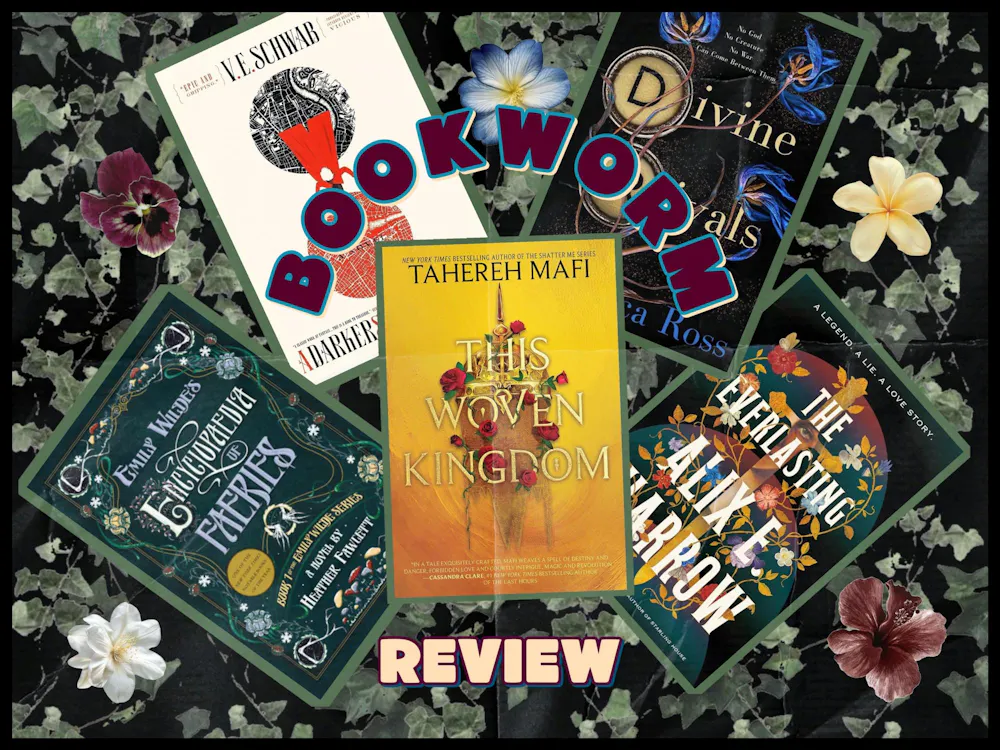
Romantasy books with yearning so exquisite they make you believe in true love
By Parker Green | 4 days agoI’ve been thinking a lot about romantasy (the sub-genre combining fantasy and romance); specifically, what makes a good one. For me, it boils down to two points: the fantasy-world plotline needs to be equally as strong as the romantic one, and the romance should be carried by a heavy, slow-burn, borderline-pathetic amount of yearning.Because I’m feeling generous, I will share five(ish) books that fit this mold exactly. Prepare to have your life changed.

Ayla’s Adventures: From rural Ohio to urban Greece
By Ayla Peden | 5 days agoFor the past nine months, I have been preparing myself for the journey that will ultimately define my early 20s: studying abroad.