
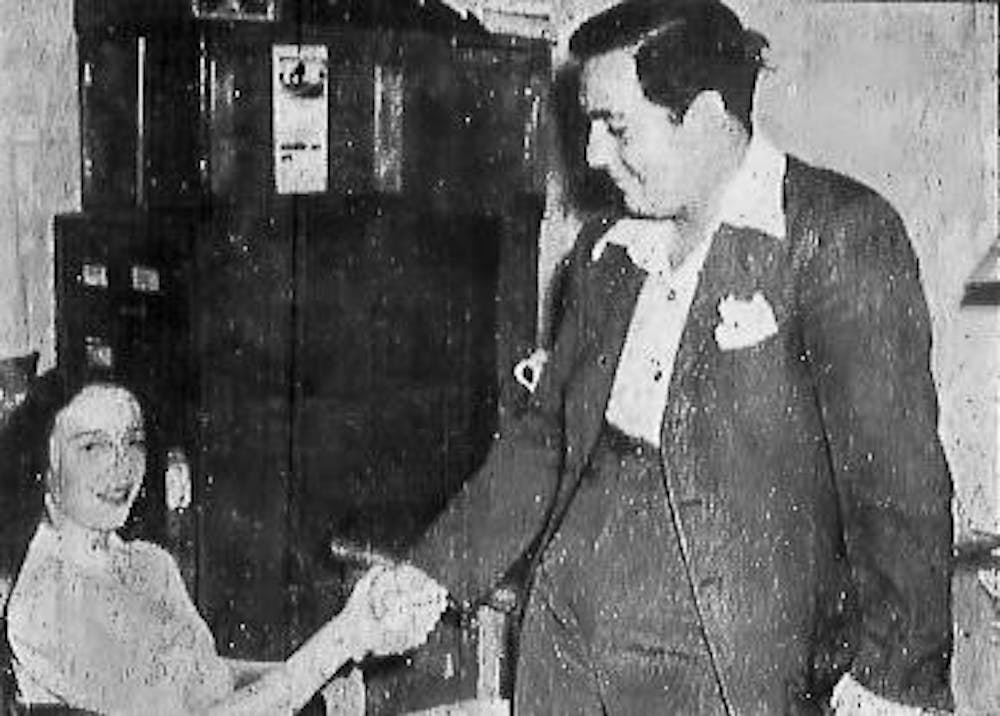
For all of the 1800s, and almost half of the 1900s, men ran the newsroom.
That was until Peggy Pauly stepped into the spotlight in 1942 as the first female editor-in-chief of The Miami Student.
Her tenure included coverage of special defense courses and naval reserve enrollment brought on by World War II, a “The World Today” section reporting on foreign relations, as well as articles on co-ed sports and updating the Miami University community on ill professors.
Pauly wasn’t the first woman on staff, though. In 1902, Beth Coulter became editor of the Normal College (education) news, Ruth Snyder became the Campus Notes editor in 1903 and Lillian Miller became alumni section editor in 1920.
Since these women laid the groundwork, many have followed in their footsteps, including 1975 editor-in-chief Kathleen Burke-Williams.
During her era, the paper was printed bi-weekly on Tuesdays and Fridays. The staff spent late nights at the Oxford Press, laying the copies out, making last-minute edits and waiting for print to be done.
“During all the time I was there, [we] covered a lot of good stories, broke a lot of news and did a lot of investigations,” Burke said. “ I really felt that even if I wasn't out there reporting, I was part of that package, kind of putting everything together, and I was always very proud of what we did.”
Although Burke and the women who came before her had seen progress for women in the newsroom, there were still traces of discrimination across campus.
She remembered a specific story she wrote with the headline: “Dining hall hiring practices modified.” Female students applied to work in the dining halls, but were told there weren’t any openings; meanwhile, men applied and got the job.
“I can't believe I didn't write this with more of a sense of outrage,” she said.
In the early ’60s, the United States Senate passed the Civil Rights Act of 1964, which included Title VII, a section prohibiting employment discrimination based on race, sex, color, religion and national origin, according to the U.S. Equal Employment Opportunity Commission (EEOC).
Title VII also created the EEOC: a five-member, bipartisan commission whose mission is to eliminate unlawful employment discrimination.
Enjoy what you're reading?
Signup for our newsletter
Burke said that back then, it wasn’t uncommon for jobs to be limited to men, even in the classified ads.
“It wasn't unusual for jobs to be sex or gender segregated,” Burke said, “but I'm looking at this, and I did write it in a straightforward manner, as opposed to getting some [women] to give me a really good quote [about] unfairness. So, I thought that was sort of interesting to look back on.”
While there were times of misogyny, Burke added that she never felt looked down upon because of her gender at Miami or at The Student.
“There was never any sense of sexism in [the newsroom] or that women on the staff were treated any differently than men, and I think that's reflected in the promotions that I got,” Burke said.
Sue Macdonald immediately followed Burke’s time as editor-in-chief with her own tenure, beginning in 1976.
She said women started joining the staff in the early 1900s because, even though Miami at the time was all men, the Oxford Female College combined with the Oxford Female Institute in 1906 to create the Oxford College for Women, according to the Walter Havighurst Special Collections.
The first woman to work at The Student was in 1902, and Mabel Briney was named the first female section editor in 1909. The first female sports editor, Anna Weber, was in 1922, according to The Miami Student archives.
Almost 50 years later, in 1971, a Harvard University study of journalists found that an estimated 22% of daily newspaper journalists were women, and women comprised nearly 11% of television journalists. Three decades later, the numbers increased to 40% and 35%, respectively.
When MacDonald graduated from Miami in 1977, she joined the Cincinnati Enquirer and was one of the first women to work on the copy desk. She gave credit to The Student.
“Everything I learned at Miami shaped my whole career and my whole life,” MacDonald said. “Journalism is important for this society to function intelligently and with some kind of soul. People have to be informed.”
Throughout the 200 years of The Student, there have been only 33 confirmed female editors-in-chief, with half of them being from the 2000s, including the current leader, Olivia Patel.
Cosette Gunter-Stratton, the 2022 editor-in-chief of The Student, is now a news producer at the WCPO9 news station in Cincinnati; however, eight years ago, she was a first-year reporter getting her feet wet in a new student organization. It wasn’t until the end of her junior year that she considered running for editor-in-chief and won alongside her managing editor, Abby Bammerlin.
While Gunter-Stratton said she took great pride in running the organization with Bammerlin, she was conscious of how the world is built against women, especially in professional settings.
“I’m sure the things I experienced as a woman in a leadership role were similar to [those of] a woman decades before me, which highlights the need for women to continue to show up in journalism — to show up and continue to prove that gender and professionalism do not have to conflict,” Gunter-Stratton said. “More importantly, to watch for the implicit biases in others and hold them accountable, which is what journalism is all about.”
Read More

Recommendations from a reminiscing junior on having roommates
By Jada Rogers | 1 hours ago"I made myself miserable as a first-year student because I refused to make other long-term friends, swayed by my own misconception that my roommate was the only person I needed. Humans crave companionship, so please go find your people."

Dorm room digest: How to not starve this semester
By Elise Hanna | 1 hours agoAs the honeymoon phase of campus life begins to wrap up, it might be hitting you that you’re reliant on the dining hall for sustenance this entire year.

Office of Community Standards updates Code of Conduct to focus on students
By Anthony Caprara | 22 hours agoWhen Alex Fields joined Miami’s staff as Director of the Office of Community Standards in April 2024, she brought a philosophy of conduct that pulls back on fear and leans into collaboration with students through a holistic approach. Fields took the initiative to apply that philosophy by collaborating with Dean of Students BaShaun Smith and the Student Life Council to reform Miami’s Code of Conduct during the fall semester of the 2026-27 academic year.