
The fall of 2021 was the beginning of my college career. Eager to find community, I jumped at the opportunity to become a Prodesse scholar.
Named after the Latin phrase inscribed on the seal in Academic Quad — Prodesse Quam Conspici — the word “prodesse” translates to "to be useful," "to do good," "to serve" or "to benefit." The program allowed incoming students to explore an interdisciplinary area of interest through a seminar course and co-curricular activities.
A young politico, fresh from the campaign trail of 2020, I chose Constitutional Conversations. This course focused on the core fundamentals of interpreting the superseding law of the United States.
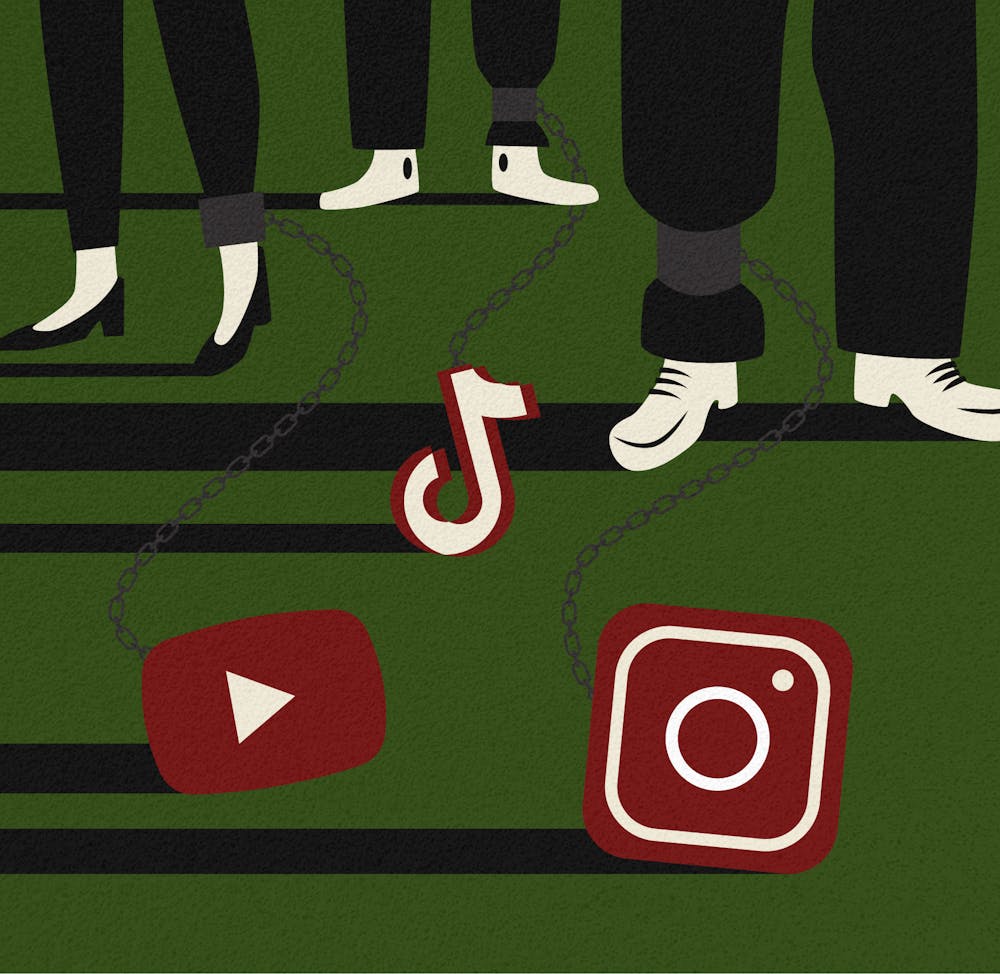
To conclude the course, we were tasked with picking a legal issue facing the U.S. and how we would approach it as a “friend” of the Constitution. I chose the First Amendment, centering my argument on regulating speech on social media platforms. This expert from my paper perfectly showcases how to approach the argument:
“Social media is an outlet for American citizens (and any citizen abroad for that matter) to express in words how they are feeling or upload a picture to keep everyone informed. For Congress to pass some sort of legislation regarding social media would directly relate to the First Amendment. It is a very complex issue that doesn't have one right answer.”
The law is complex because each human experience is unique, and our laws should take that into account. That's why we have a court of our peers, ones that we hope empathize and relate to us.
But don’t let me decide for you. To understand how to tackle this issue, you must first think like a legal scholar or justice for yourself.
A liberal constitutionalist is often viewed as someone who takes into account the modern context of law and how the document writers may have made the decision if they were here, which could expand powers.
A constitutional constructivist usually airs on the side of caution, believing the text of the Constitution should be interpreted in the terms and context of those who wrote the document. Or you may be a loose constructional constitutionalist, viewing the document as living and changing but keeping in mind the founders’ intentions.
All justices have one common goal: to uphold the U.S. Constitution.
Since the publication of my essay, “Is social media cause for congressional concern?” I have graduated into an America that looks much like the one I left when I entered college.
But Europe has since progressed along.
Enjoy what you're reading?
Signup for our newsletter
In 2022, the European Union (EU) passed the Digital Services Act. “Its main goal is to prevent illegal and harmful activities online and the spread of disinformation,” according to a EU website.
When researching what the U.S. has enacted since 2021, it is dismal to say the least. Many of the acts have focused on those under 18.
The internet in the U.S. is still very much the wild west of free market capitalism; the tech companies continue to use U.S. citizens as a testing population while the rest of the world stands up for its citizens.
The EU’s law also benefits businesses, not just citizens, for those who want to argue the economic impact of regulation. Having these regulations helps outline how businesses need to take steps to scale effectively and efficiently.
But I want to make this clear: We have seen internet laws be used to silence citizens at the hands of authoritarian leaders.
Freedom House is a nonprofit organization that performs the Freedom on the Net project. The project is described as “ground-breaking research and analysis, fact-based advocacy, and on-the-ground capacity building.”
This project is particularly useful to understand how the internet and speech is regulated across the world.
America ranks 73 out of 100 on the report, much better than Russia or China, which respectively rank 17 and 9.
These rankings are determined on a scale that takes into account local laws, jurisdiction and administration changes.
In modern America, a social media cancellation feels more powerful than a court ruling. American journalists and media personalities are relentlessly ridiculed, until it bleeds into reality, as we horrifically witnessed on Sept. 10.
The real question for American legal scholars should be, “How will the internet affect democracy? Should we consider what the founding fathers would use the internet for? Would we use it the same way we do? Or should we look at the facts about how the internet is affecting those who are actively using it in the present?”
The U.S. still has little to no regulation for emerging technologies. What will the impact be on our democracy? What will be the straw that breaks the First Amendment's back?
I’m still left with the same question nearly five years later: Is social media, specifically the internet, a cause for congressional concern?
Landon C. Morrison is a proud Miami University alumnus (’24, B.A. in Emerging Technology in Business and Design; ’25, Master’s in Entrepreneurship and Emerging Technology). Based in the Lexington, Kentucky region, Landon writes with a focus on politics, pop culture and entrepreneurship – exploring how these topics shape everyday lives.
At The Student, we are committed to engaging with our audience and listening to feedback. This includes publishing a diverse array of guest editorials. For more information on guidelines and processes, email Taylor Powers, The Student's opinion editor, at powerstj@miamioh.edu.
Read More

Fan base vs. fandom: The gendered difference
By Layla Norris | 10 hours ago"Why can men slip free from societal judgement, but every movement of young women is scrutinized? These girls are not ridiculous or hysterical — at least, not any more than their male counterparts are."

Becoming an adult when everything’s so expensive is a nightmare
By Eliza Sullivan | Yesterday"Many people are rightfully upset with the economy. But just being frustrated is not a plan of action."

Finding Miami’s AEDs shouldn’t be a scavenger hunt
By Vedika Kaushal | 2 days ago"We don’t keep fire extinguishers around because we expect our buildings to catch fire every Tuesday. We keep them around because if something does happen, waiting for someone else to arrive is not much of a plan."