
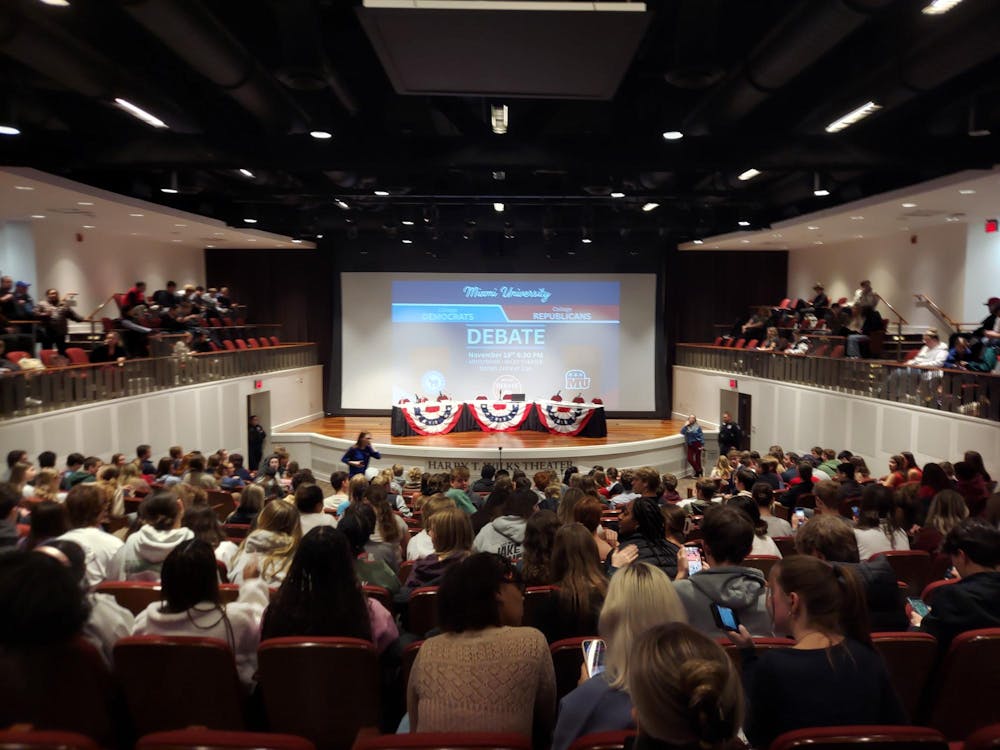
The first of 11 topics debated on the evening of Nov. 19 between the Miami University College Republicans and College Democrats was the role of diversity, equity and inclusion (DEI) programs in K-12 and college. The two sides gathered for a debate in Wilks Theater, located in Armstrong Student Center.
The three College Republicans at the table argued that DEI practices are inherently racist, as they directly support specific demographics, citing Harvard v. Students for Fair Admission as evidence of DEI’s possible problems. The College Democrats, also with three members, countered by arguing that lifting up the disadvantaged helps all people. The Democrats agreed with the Republicans that race-based quotas for college admission is a flawed solution, but said they believed they had an overall positive impact.
The debate continued with the topic of censorship of LGBTQ+ material in schools. The Republicans support sex education for the purpose of understanding the process of puberty, but believe that parents have the right to control how their children learn about LQBTQ+ topics.
“This isn’t about gay sexual content or straight sexual content,” Republican debater Austin Andrews said. “This is just about how we shouldn't be showing sexual content to third graders.”
The College Democrats responded by highlighting the importance of exposing students to people who are different from them and by arguing that LGBTQ+ romantic acts in media are often exaggerated and that kissing does not constitute obscene sexual content.
The debaters then started on the topic of abortion.
College Democrat debater Max Tumbleson said when it comes to abortion as a whole, it should be up to the federal government to make it a right for every citizen.
“I don’t think anybody here would expect to go into surgery one day and wake up with one of their lungs missing, or their liver,” Tumbleson said. “It is your right as a human being to decide what in your body gets used and what for, including your reproductive organs.”
Republican debater Hannah Pickerrell responded to Tumbleson, criticising his analogy.
“I think comparing abortion to the loss of a kidney or a lung is a gross misrepresentation of a human life … absolutely disgusting,” Pickerrell said. “It’s not a question of, ‘When is it OK to intentionally take an innocent human life?’ It’s a question of, ‘What is a human life?’ … We know that at conception, a life is formed. You have distinct DNA. This is not a question of ‘What if the woman is in danger?’ Bodily autonomy ends when you’re harming another life.”
Pickerrell’s comments were met with audience applause.
The Democrats said women should have the choice to get an abortion because of cases where the mother would not be able to provide a good life for the child.
Enjoy what you're reading?
Signup for our newsletter
The Republicans countered by saying that the child could be put up for adoption. The Democrats responded by saying the adoption system is flawed, to which the Republicans agreed. They still supported women carrying the child until birth and then putting them up for adoption.
When discussing gun control policy, the Republicans argued that gun violence is largely a result of poor mental health, citing a Pew research study that determined nearly six out of 10 gun deaths were a result of suicide.
The Republicans also argued that the Second Amendment is necessary for the protection of United States citizens and for preventing tyranny.
The Democrats argued that red flag laws restricting some people’s right to own firearms should be expanded and punishments should be enacted for gun owners who do not properly secure their weapons. Republicans responded by saying red flag laws violate due process and that arming responsible citizens increases safety, using the example of the Greenwood Park Mall mass shooting. They followed by saying gun policy reform is not currently necessary.
The topic of campus antisemitism followed the debate on abortion and gun laws.
Both sides agreed that antisemitism stems from a lack of education and that accusations of antisemitism should not be used to stifle criticisms of Israel.
As the conversation shifted to the Israel-Hamas war, the Democrats criticized Israel’s destruction of Gaza and their bombing of schools and hospitals. The Republicans countered by saying “such actions were necessary to combat Hamas.”
The Democrats advocated for a solution that allows for Israel and Palestine to co-exist peacefully, while the Republicans viewed a two-state solution to be the best.
“Hamas does not want peace; they don’t want to co-exist; they want to wipe out the other side,” Andrews said.
“Just as Israel would like to wipe out the Palestinians,” Tumbleson rebuttled.
When it came to economics, the Democrats criticized the Trump Administration’s use of tariffs, the growing national debt and Trump’s tax cuts for the wealthy. The Republicans agreed that tariffs can be misused but can also be valuable bargaining chips.
The Republicans defended the tax cuts, claiming that the savings would be reinvested into U.S. businesses, creating jobs. The Republicans agreed that the national debt is a problem, but said they wish to cut back spending on social security. The Democrats advocated for a reduction in defense spending and a revision of tax laws.
The final topic of the debate was immigration policy. Both sides agreed that the current immigration system is flawed, but the Republicans argued that undocumented immigrants need to be deported first and then the system can be fixed.
The debate resulted in an at-capacity Wilks Theater, with some people being turned away. For the students who did attend, their reactions to the debate were positive.
Lyla Stockberger, a first-year sociology and social work major, said she found the debate productive.
“I thought it was good,” Stockberger said. “Both sides presented themselves in a civilised manner; obviously, there were some heated topics, but everyone spoke well and got their points across.”
Barrett LeMaster, a first-year accounting major and vice president of Miami’s Turning Point USA chapter, said he also enjoyed the debate, but he wished the two sides were able to focus more on finding solutions.
“I know how much work the College Democrats and Republicans put into this,” LeMaster said. “I know each and every one of those people studied extensively and they put on a great show. I don’t think enough was said about the future … finding middle ground is so integral, as a country, we don’t have to agree on everything, but we do need to make progress.”
Read More

‘The flip side of fear is understanding:’ Q&A with Rick Steves
By Evelyn Dugan | March 22, 2026Prior to his lecture in a packed Harry T. Wilks Theater, Rick Steves sat down with The Miami Student in a humble Williams Hall conference room – professional writer to student journalist.

Preview: No. 11 seed Miami to face No. 6 seed Tennessee in first round of NCAA tournament
By Graham Young | March 19, 2026The Miami University RedHawks men's basketball team will face the University of Tennessee Volunteers at 4:25 p.m. on March 20.
ASG passes resolutions supporting the return of the Victory Bell rivalry, improving syllabus transparency and redesigning diplomas
By Kathryn Hippe | March 19, 2026Associated Student Government (ASG) passed a resolution reinstating the historic Victory Bell rivalry between Miami University and the University of Cincinnati (UC), while also passing resolutions requiring earlier access to course syllabi and redesigning university diplomas.