
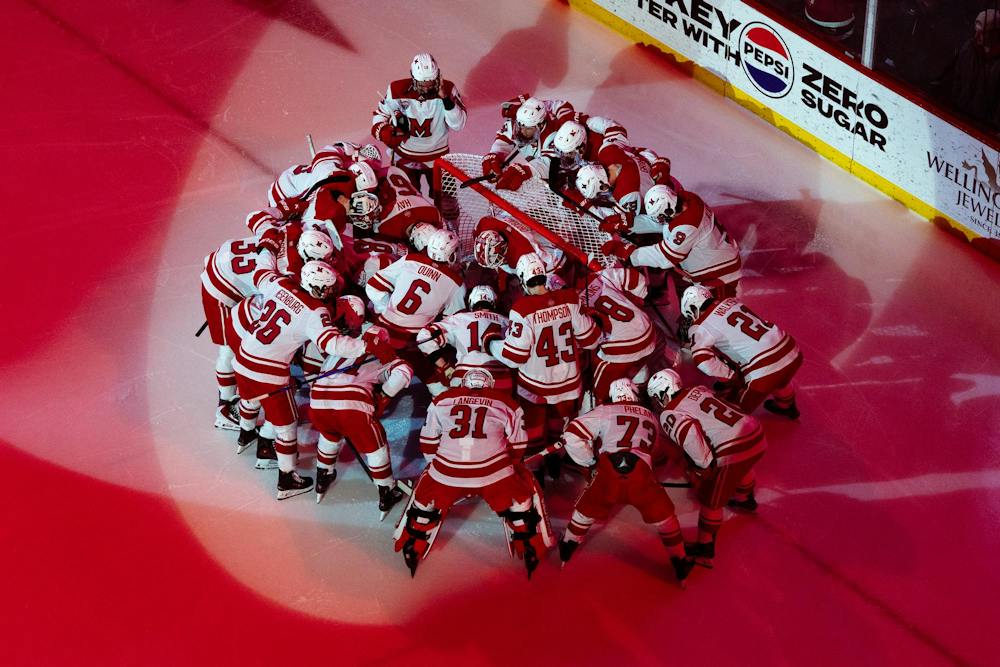
Before last season, the National Collegiate Athletic Association (NCAA) made a landmark rule change that allowed hockey players who had previously played in the Canadian Hockey League (CHL) to play college hockey. Prior to the ruling, these players were seen as having lost their amateur status due to the CHL giving players stipends. The NCAA deemed them as professional payments.
The Miami University Redhawks men’s hockey team quickly jumped on this new recruiting opportunity, bringing in three recruits from the CHL for the 25-26 season and one more for the upcoming 26-27 season.
“The biggest thing in coming to college was just having an opportunity to extend my runway of playing hockey before I turn pro,” sophomore forward Kocha Delic said.
While in juniors, he was a consistent point-per-game player for the Sudbury Wolves and has continued to be a key player for Miami, leading the team in points last season. The transition to the college game was not the easiest for many players who had to adjust their style of play away from the CHL.
Over-age players, which refers to players who are 19 and 20 in juniors, could physically dominate less developed competition, since the age range is 16 to 20. In college, the size and skill discrepancy is much less, because the ages of players are typically 18 to 24.
The physical difference between 16 and 20-year-olds is much greater, so junior level stunts the development of older players to become level with their younger competition. This is the reason many junior players have taken the opportunity to play in college.
There is less room on the ice to possess the puck as an individual, so junior players are forced to learn a more team-oriented style that prioritizes establishing offensive zone play and defensive responsibility. Because of this, junior players have changed the way they approach developing their game at Miami.
“A big focus for me was playing a little bit more defensively,” Delic said. “In college, the games are tighter, I guess you could say. In the OHL it’s a little bit more open, where guys play a little bit more up and down the ice, working east-west, versus college, it’s a lot of north-south. You’re just getting pucks in deep and holding onto pucks, and you have to wait and pick and choose your moments.”
The competition in college hockey is bigger, older and more physical. The season has half as many games as the CHL, so each one is more significant to the overall standings, and players are forced to treat every game like it’s the difference between making the playoffs or not.
“You just have less time and space,” said freshman defenseman Timofei Runtso. “There is always a stick on your stick, and whatever space you have, you just got to be ready to adjust to it and play it however you can.”
Last year Runtso spent a season in juniors with the Victoria Royals of the CHL.
“I think there is some pressure, but as an athlete, you’re supposed to get used to pressure and the pressure of always performing,” Runtso said. “I think that it’s something I’ve kind of gotten used to, especially playing in front of some big crowds in the WHL. So it’s just part of the job.”
Enjoy what you're reading?
Signup for our newsletter
This summer, Runtso was drafted in the second round of the 2026 NHL draft by the Montreal Canadiens. He and the other CHL players are no strangers to the stress that comes with high-level sports.
Stress has been a key factor in these players’ success in college hockey. Although the switch from juniors to college is a big one, they already possess the mental toughness to adapt to new environments and new playing styles. For Miami specifically, the addition of these junior players to the team has played a huge role in their recent turnaround under head coach Anthony Noreen, going from 3-28-3 in his first season as head coach to 18-16-2 last season.
“[The coaching staff is] building something special here,” Runtso said “… I came here and visited campus and kind of just fell in love with it. They were saying how they’re building something special, and they believed in it, which made me believe in it.”
Miami comes into this season ranked No. 5 out of 10 in the NCHC pre-season poll and is receiving votes for the national top 20, a huge jump from their 2024-25 season dead-last finish.
Overall, this rule change has been extremely beneficial to both the four junior players who have made the transition and to Miami’s hockey team. The team looks to be back in the NCAA Hockey Tournament for the first time since 2015.
Read More

Recap: Miami drops tough loss to Bowling Green, 24-20
By Pete Hartlage | 10 hours agoThe Miami University RedHawks (2-3) opened Mid-American Conference (MAC) play against the Bowling Green State University Falcons (1-4) on Oct. 3 at Yager Stadium.
Miami Men's basketball schedule review
By Jake O'Bruba | YesterdayThe Miami University men’s basketball schedule has officially been released. Coming off an undefeated regular season last year, the RedHawks look to replicate the success of a magical 2025-26 season.
Preview: Miami football begins conference play against Bowling Green
By Jacob Light | YesterdayThe Miami University RedHawks (2-2) will face the Bowling Green State University Falcons (0-4) at 3:30 p.m. on Saturday, Oct. 3 at Yager Stadium.