
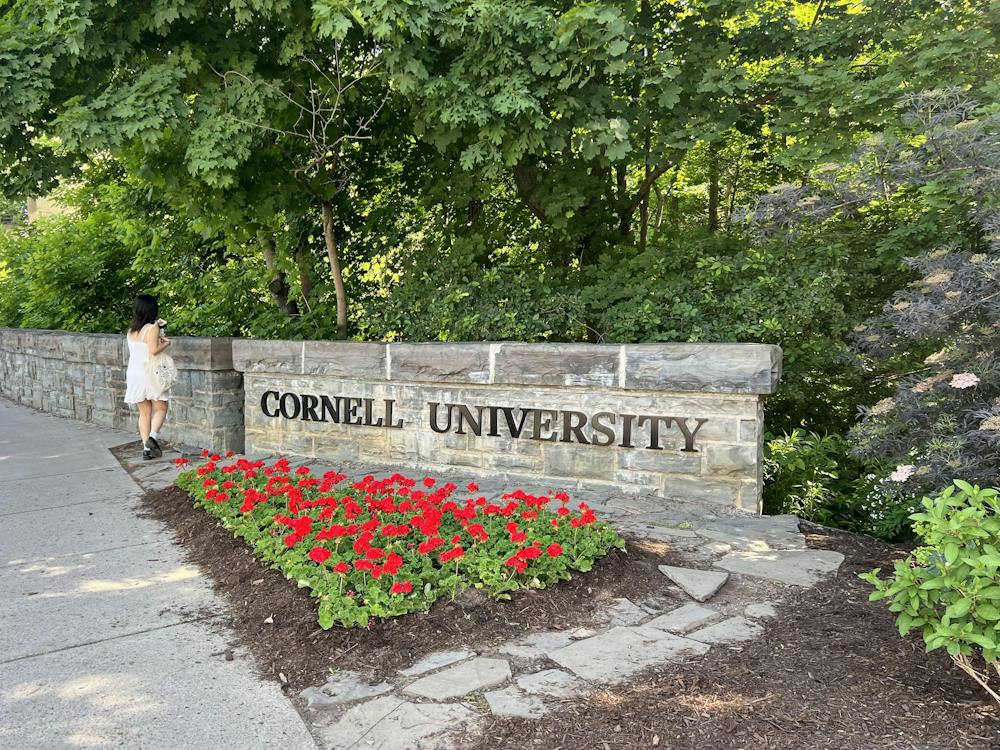
Cornell University says it is committed to providing a “safe, inclusive, and respectful” environment for its students. Its policies prohibit sexual assault. Its offices investigate complaints. Its reports count incidents. Its administrators issue statements expressing concern. This all sounds reassuring, until a student actually needs those promises to be held.
In October 2024, a Cornell student was allegedly sexually assaulted by multiple men at the Chi Phi fraternity house.
According to a civil lawsuit filed in September, the student was intoxicated when she went to the fraternity house, where she alleges she was coerced into consuming ketamine and other substances before being sexually assaulted by seven fraternity members. She reported the incident to Cornell police on Nov. 8, 2024.
Cornell subsequently opened a Title IX investigation that included at least 12 hearings. The lawsuit alleges only two of the seven accused students were expelled and that others received lesser sanctions. The plaintiff ultimately left Cornell.
The allegations are horrifying, but they remain allegations. The defendants have not been criminally convicted, and the District Attorney Matthew Van Houten has emphasized that the woman’s original statement to police differed significantly from the allegations in the civil complaint.
Now, the district attorney has reopened the investigation and said prosecutors intend to present the case to a grand jury, citing the possibility of additional evidence that was not available in 2024.
Cornell’s response has been remarkably familiar: The university said it takes sexual violence seriously, it conducted a separate Title IX investigation and disciplinary proceedings resulted in sanctions. Cornell also emphasized that federal privacy law prevents it from discussing individual disciplinary outcomes.
Those statements may be legally necessary. They are also profoundly unsatisfying.
A university cannot ask students to trust its systems and then expect “We followed our procedures” to be the end of the conversation when those systems are called into question. Protocols are supposed to produce accountability, not simply demonstrate that an institution has procedures.
This is not an argument for abandoning due process. An allegation is not a conviction, and the criminal justice system has evidentiary standards for a reason. But due process cannot become a euphemism for institutional paralysis, and concern cannot become a substitute for action.
There are two separate questions here. The first is whether a crime occurred and whether it can be proven under the applicable legal standard. The second is whether the institutions around the student did everything they reasonably could to investigate the report, support her afterward and examine whether their own systems failed the student.
The second question does not disappear because the first is difficult. It becomes more important.
Enjoy what you're reading?
Signup for our newsletter
Cornell already knew that sexual violence was not some remote possibility on its campus. Its 2024 Annual Security Report recorded 28 on-campus reports of rape in 2023, up from seven in 2021. These numbers cannot tell us what happened in this individual case, but they make it impossible to pretend sexual violence is an unforeseeable anomaly that occasionally arrives at an otherwise safe institution.
If the university conducted an investigation involving 12 hearings, what did it conclude? Why did it produce the sanctions it did? Two students were expelled, while five others were required to complete an essay.
Cornell does not need to compromise an ongoing criminal investigation or violate student privacy. It does need to demonstrate that its systems are capable of recognizing failures and correcting them.
That responsibility is particularly important because, according to the lawsuit, the student ultimately left the university she had once considered her dream school. A student reported an alleged sexual assault, entered the institution’s investigative machinery and eventually left campus. If that account is even substantially accurate, Cornell has to confront more than whether it followed its policies. It has to ask whether those policies actually protected the student they were supposed to serve.
Cornell has policies. What it owes its students is something more difficult: evidence that all of those things actually work when someone needs them.
It is a failure of the institution. It is a failure of the system. It is a failure of the community.
Most importantly, it is a failure of the promise Cornell made to the student who trusted it. Students deserve considerably more than that.
Eleanor Jones is a senior honors political science major with minors in business, English and religion from Philadelphia, Pennsylvania. She serves as co-chair of YDSA and also participates in Women in Political Science and Women Helping Women. Her interests include literature, law, medicine and travel.
Read More

Neutrality is not the same as innocence
By Eleanor Jones | 10 hours ago"Nobody is suggesting that Sheeran secretly sat in a back room and personally drafted the eviction notice. The point is more uncomfortable than that. You can be deeply involved in the circumstances surrounding a decision without being the person who officially makes it."

‘Practical Magic 2’: Shenanigans
By Eliza Garrett | 2 days agoThe Owens sisters are back after nearly three decades, and this time, they have even more magic, family drama and romance than ever before. “Practical Magic 2” brings Gillian and Sally Owens back to the big screen and allows the audience to experience their magic once again.

Lizzy McAlpine makes folk her own in ‘Angel’
By Ren Chaffee | 4 days ago“Angel,” Lizzy McAlpine’s new album, released Sept. 18. Although there are some mixed reviews, “Angel” hits the mark for me.