
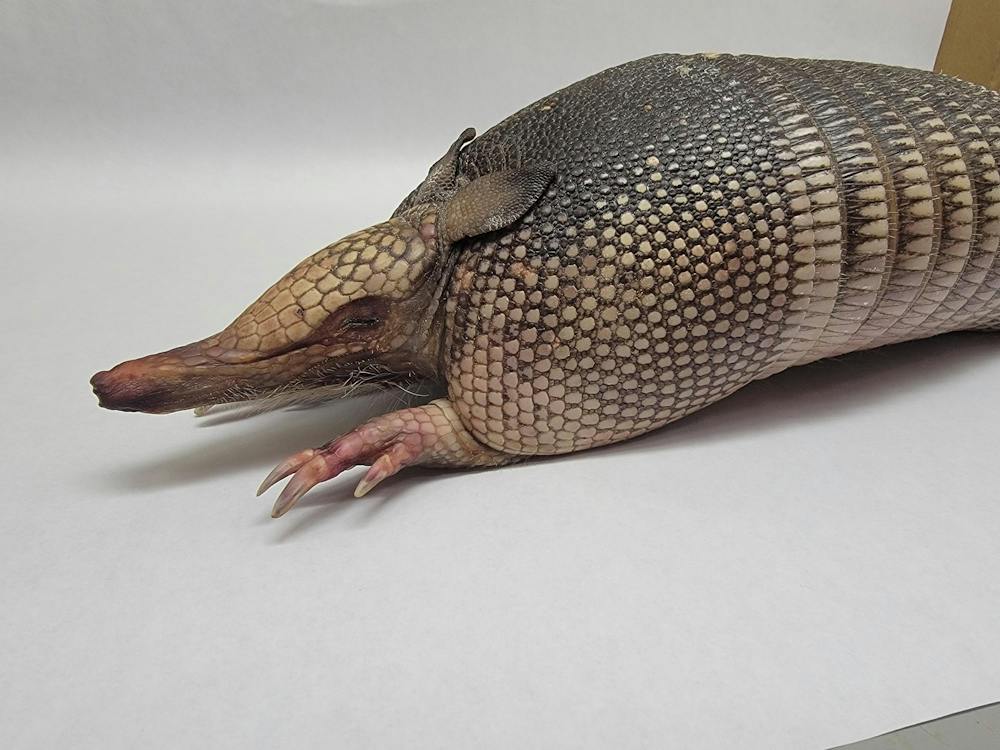
The discovery of a migratory Mexican long-nosed armadillo four miles east of Oxford, Ohio presents new opportunities for research about genetic adaptations and climate change. When an Oxford resident found it dead after being struck by a vehicle, the armadillo was sent to Miami University’s biology department and the Jezkova lab.
Armadillos originated in South America and migrated north from Mexico to Texas in the 1850s. In Texas, they had no predators and found plenty of resources to eat and live. The Mexican long-nosed armadillo also always gives birth to identical quadruplets, resulting in a steadily growing population.
As southern states get hotter and drier, armadillo populations have moved to northern states in search of warmer winters. This specific armadillo is the first documented migratory armadillo found in Ohio.
Tereza Jezkova, the Jezkova lab principle investigator and associate professor, said her lab looks at species’ response to environmental change and genetic adaptations that help animals, like the armadillo, cope with thermal changes.
Jezkova said climate change is a reason for the migration, but it is not the entire story. She said the discovery will allow her lab to conduct research on the armadillo to understand if they are adapting genetically to the cold and are beginning to tolerate much colder temperatures.
“We are interested in whether the armadillos are somehow cheating the system,” Jezkova said. “That they are maybe finding some human structures to stay at when it’s super cold, in the hay or underneath stables, or if they’re adapting genetically. That would mean that something is changing with them physiologically.”
In the next steps of research, Bhuwan Singh Bist, a Ph.D candidate in the Jezkova Lab, said they will use tissue samples from the armadillo to conduct genotype testing. They will test to see genetic variations between the Midwestern armadillo populations compared to the populations in Texas.
“Research is definitely needed at the epigenetic level of what is the influence of climatic change,” Bist said. “The change in climate or any other factors that are driving the species to survive environmental conditions of Illinois, Indiana or Ohio, contrasted with extreme hot seasons over in Florida, Alabama, Louisiana.”
Steven Sullivan, director of the Hefner Museum of Natural History, has been analyzing the animal while preparing to taxidermy it. He said he found no indication that this armadillo was captive, because captive animals tend to grow abnormal teeth and nails. They also tend to be obese and have dirt in their crevices, but Sullivan said this armadillo was “pristine.”
To understand why this armadillo migrated north, Sullivan said to look to climate change models to help to understand the past, interpret the present and try to predict the future. The best way to validate these models is to have organisms, like the armadillo, that can offer insight into how aggressive or conservative a model is.
When looking at climate change, Sullivan also talked about the 1.5 degrees Celsius climate threshold, known as the global average surface warming of 1.5 degrees Celsius above pre-industrial temperatures. This threshold sets a goal that by the year 2100, the earth’s temperature should not rise by 1.5 degrees Celsius according to the National Oceanic and Atmospheric Administration (NOAA). He said the discovery of the armadillo in Ohio warns us about the current state of the climate threshold.
“It’s because we recognize that when we go beyond that threshold, everything falls out of whack and it goes crazy,” Sullivan said. “This armadillo is saying, ‘Hey folks, you’re pretty darn close to everything going out of whack,’ and so it’s kind of scary.”
Enjoy what you're reading?
Signup for our newsletter
Moving forward, the Jezkova Lab has proposed research to further understand why this migration phenomenon is happening. They will bring southern armadillos from Texas and northern armadillos from Illinois to conduct genome testing to see if there is evidence of adaptation. Jezkova said they are currently working on finding funding for the research before they can start.
The Mexican long-nosed armadillo found in Oxford will be taxidermied and will debut on Thursday, Oct. 8 in the Hefner Museum after the Hefner lecture, “Latin American Birds, Connecting Your Home to the Tropics.”
Read More

We’re applying 18th-century worldview to today’s society
By Ethan Foster | Yesterday"This creates a real problem because originalists attempt to solve these debates through worldviews contemporary to the time they were written. These perceptions are oftentimes completely different than the ones we have today."

Do Oxford bars card hard for Miami student IDs?
By Erin Wadzinski | YesterdayIn Oxford, a Miami University student ID holds power. It authorizes meal purchases, dorm entry and laundry cycles. A more unexpected perk lies in the admission it grants to popular bars Uptown.

Miami Men's basketball schedule review
By Jake O'Bruba | 2 days agoThe Miami University men’s basketball schedule has officially been released. Coming off an undefeated regular season last year, the RedHawks look to replicate the success of a magical 2025-26 season.