
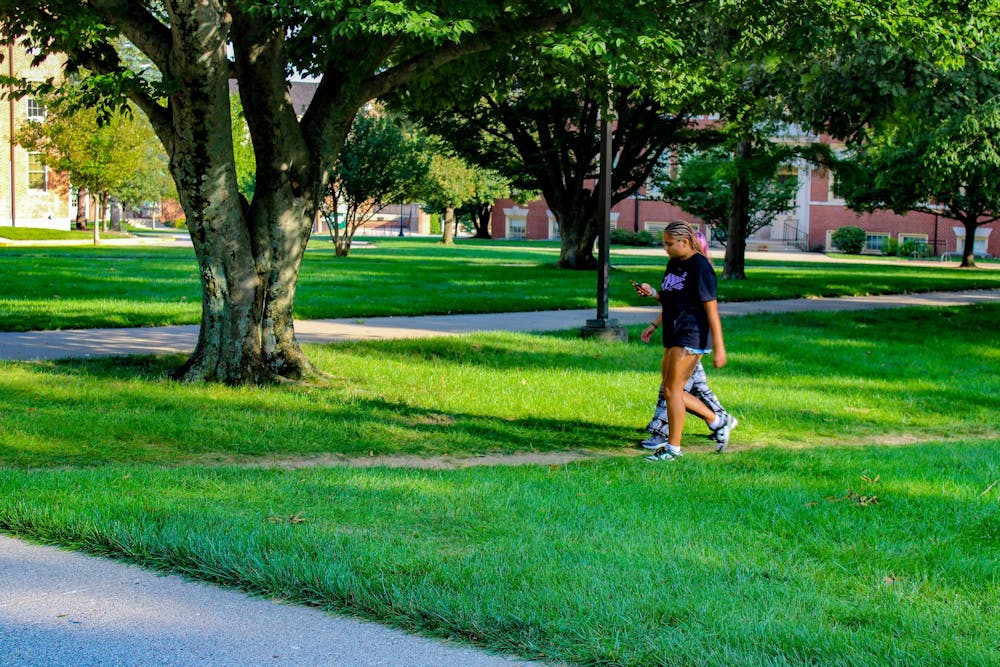
Like some students, I like to take shortcuts. I also came to Miami University because I fell in love with the campus one summer, adorned with its landmarks, great expanses of grass and campus tours.
When I moved into Hodge Hall, I remembered looking out my window but having none of those things come to mind. Instead, there was a crude dirt path that briefly crossed the entrance stairs and the main path that snaked through Western campus.
I couldn’t decide how I felt about it. It was lazy — that was certainly true — but was it really that surprising?
Even in middle school, we were taught the length of the hypotenuse will be shorter than the sum of its legs; reaffirming what everyone already did across the playground and corners of the gymnasium to finish laps earlier. But these dirt paths couldn’t have been more than a couple feet, maybe capable of shaving off a few seconds on any ETA, but nothing substantial.
Once classes started, I watched students divvy up between walking on cement and drifting deeper into the dirt. The trail, which I later learned was categorized as a “desire path,” persisted through the yellowing grass and heavy snow. Even through mud, which allowed me to witness my first slip-n-slide on campus.
When I returned in the spring, it was patched by a thin, bright green strip only slightly outlined by what it could not cover. It was insignificant in hindsight, but it left me bittersweet.
You never know what you’ll miss until it’s gone, and this was just one of many examples. Desire paths are informal human or animal-created paths created by foot traffic. Over the years, Miami has had quite a few, but they’ve been slowly disappearing from campus.
Sometimes they become a patch job, like what happened to the one outside Hodge, but the more popular, permanent approach consisted of using these paths as urban planning guidelines. What was worn down is freshly paved over out of convenience. A few examples of this include the path between Goggin Ice Center and Phillips Hall and another connecting Hamilton Hall to the sundial.
Miami isn’t unique in this process. Ohio State University’s Oval was shaped from students cutting into the central green area — eventually forming the geometric patterns we associate with the Oval. While this was discouraged at first, the university caved. Though the paved path was initially banned to first-year students, it eventually blossomed into a student commuting hub that occasionally hosts events.
Other places, like the University of Michigan, take the more literal approach, using student desire paths as direct inspiration for the campus’ layout, either becoming formalized or kept in their natural state like in the Nichols Arboretum.
According to Aaron Williams, University of Wisconsin-Madison’s campus planner, we form desire paths out of time efficiency, experience and resistance. There’s a certain allure to human-made trails, especially if you already see other students using them. It’s not too dissimilar from why we jaywalk so frequently: We have somewhere to be, and if that means breaking out of conventions a bit, so be it.
It’s hard to imagine Miami without Slant Walk or the dozen X-shaped crosses between buildings. Human instinct has made college more convenient and conducive for student engagement. For example, events like Mega Fair wouldn’t be possible if there weren’t so many sidewalks to host it along. Accessibility has also been boosted as a result of leaning into a more curved and user-friendly layout near building entrances. You would be hard pressed to find a side without an open door.
Enjoy what you're reading?
Signup for our newsletter
There’s no doubt that Miami looks very different from the campus Robert Frost visited, but you would be hard-pressed to find a student or townie who hasn’t been subjected to his exact quote. In a place where the “road not taken” is either suppressed or simply paved, it’s interesting to see how only some aspects of the student experience are taken into consideration — even begrudgingly so. Students may make the physical mark on-campus, but at the end of the day, it’s the university that decides which of those changes should stay.
It’s hard to say the exact level of intentionality Miami University had in mind when designing the campus and the choices students would make. Ironically, there’s still a lot to be desired from the desire paths that haven’t been snuffed out.
Maureen Wilson is a junior double majoring in media and communication and interactive media and design and minoring in creative writing. She’s an Opinion writer and photographer for The Student, marketing chair of the Asian American Association and proud member of Sigma Tau Delta.
Read More

In the editor’s rotation: My favorite time of year
By Stella Powers | 3455 minutes agoIt’s finally fall, which means it’s pumpkin spice latte, sweaters and scary movie season — my favorite. It also means it’s time to add some autumn flair to your playlists to get into the cozy spirit of the season.

What happens when the world stops coming to campus?
By Vedika Kaushal | Yesterday"People have been traveling across borders to learn languages, study different intellectual traditions and bring new ideas back with them for centuries. That exchange is not new, and I don’t think it’s something we should lose sight of now."

Shows to keep you entertained this fall
By Ren Chaffee | YesterdaySometimes the transition into fall can be scary. The weather inevitably gets colder, and class begins again. The perfect way to fight the impending sense of doom is to watch a good show.