
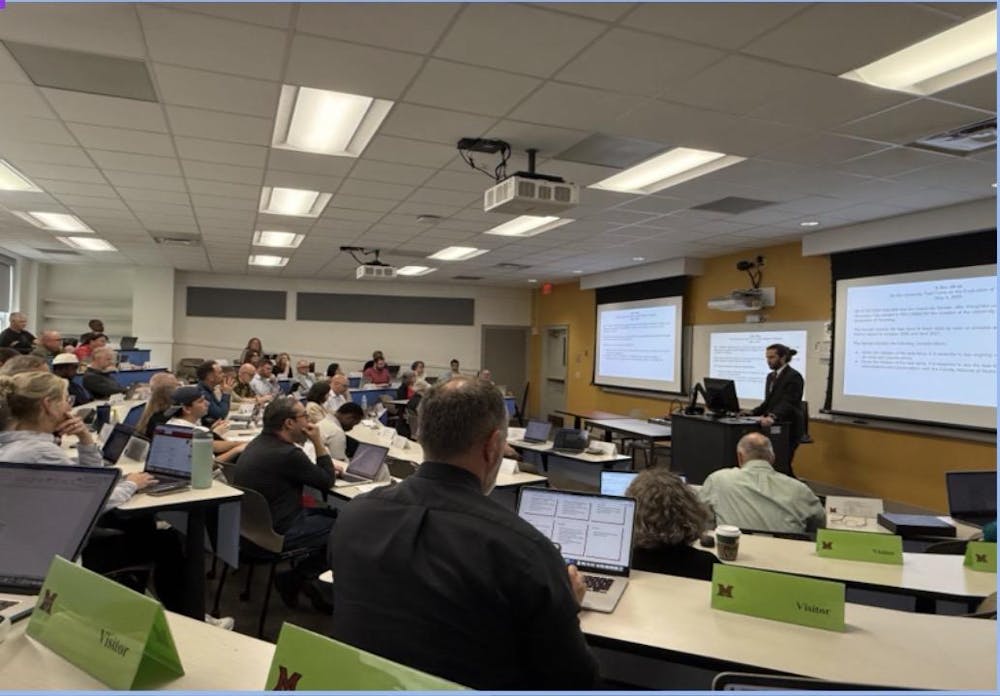
The University Senate debated academic attendance policy changes and discussed student advocacy and the future of the senate in its final meeting of the semester on Monday.
Nathan French, vice chair of senate and chair of the Senate Executive Committee, began by thanking Provost Chris Makaroff and former Senate Chair Rosemary Pennington for their contributions to the university and senate.
“This has been a year of upheaval and change for the institution,” French said. “Provost Makaroff has been a steady hand for these changes.”
Upon a survey taken by the body, French said the body agreed that leadership communicated issues clearly, but senators felt removed from major university decision making.
To address those concerns, the Senate Executive Committee plans to review committee structures, roles and responsibilities during the next academic year.
French nominated and approved Cheryl Young, Kevin Reutting and Tom Heuer for the legislative committee.
Enjoy what you're reading?
Signup for our newsletter
Carol Fabby, associate professor of the physics department, and Adam Beissel, associate professor of sports leadership and management, discussed revisions from the Council of Academic Deans to attendance policy changes previously approved by the body.
Senators expressed concerns as they believe the new policy will create extra burdens for faculty members teaching a large number of students.
“I’ve been told by several people that teach sections of 200 plus that they are going to remove all low stakes in class assignments,” one senator said. “They don’t want to be making up 10 assignments every class period.”
Provost Makaroff assured the body that was not the case, stating the original wording was vague.
“The deans would like to work with faculty to be reasonable in setting policies that are not burdensome for the faculty member, but also take into consideration the students point of view,” Makaroff said.
Despite frustrations from the body, the senate approved the policy revisions while adding language requesting a follow up report next academic year in order to address implementation and questions raised.
Ted Peters, assistant vice president and university registrar, presented revisions to the university registration policy lowering the maximum number of credit hours students can register without approval from 20 to 18.
The change was made to avoid confusion with overload fees students may be unaware of.
Cathy Wagner, professor of English, spoke about the sense of senate resolution, “We Commit to Putting Students First,” created to support affordable education, research and student safety.
“Censorship has no place on a college campus,” Wagner said. “Education is a right, not a privilege. Diverse thinking leads to excellence in all fields of endeavor.”
Debate on whether this discussion from the senate is productive or political began among the body. Student representatives said the resolutions will create division instead of creating change.
“I just think when you make these statements, it just adds noise,” the student said. “It tends to bring the flack on us and more negative attention.”
Another senator disagreed.
“I honestly don’t see what’s political about this,” she said. “It shows support for students, regardless of what they believe.”
The body voted to pass the resolution.
The senate also approved the policy to remove the “S” and “U,” satisfactory and unsatisfactory placeholder grades, and only use A-F letter grades or pass/fail grades on student records.
French closed the meeting, thanking the body for their work and discussions throughout the year.
Read More

Board of Trustees adopts 2027 budget, approves funding for FSB project
By Shannon Mahoney | July 1, 2026The Miami University Board of Trustees approved the fiscal year 2027 budget and heard presentations on MiamiTHRIVE and athletics at their June 26 meeting. The board also authorized the creation of the Cleveland Clinic president’s fund, which would be used partially to fund the joint quantum computing initiative with the Cleveland Clinic.

Board of Trustees approves Miami Plan changes, AI in majors and departmental mergers
By Shannon Mahoney | May 21, 2026Miami University’s Board of Trustees voted to approve the Miami Integrated Learning Experience (MILE), the addition of AI across all majors, departmental mergers and increasing tuition and fees for the incoming cohort.

Police raid house, seize cocaine
By Shannon Mahoney | May 14, 2026A SWAT and Oxford Police Department (OPD) team was seen raiding 16 E. Walnut St., a house named “Mtn Dew.”