
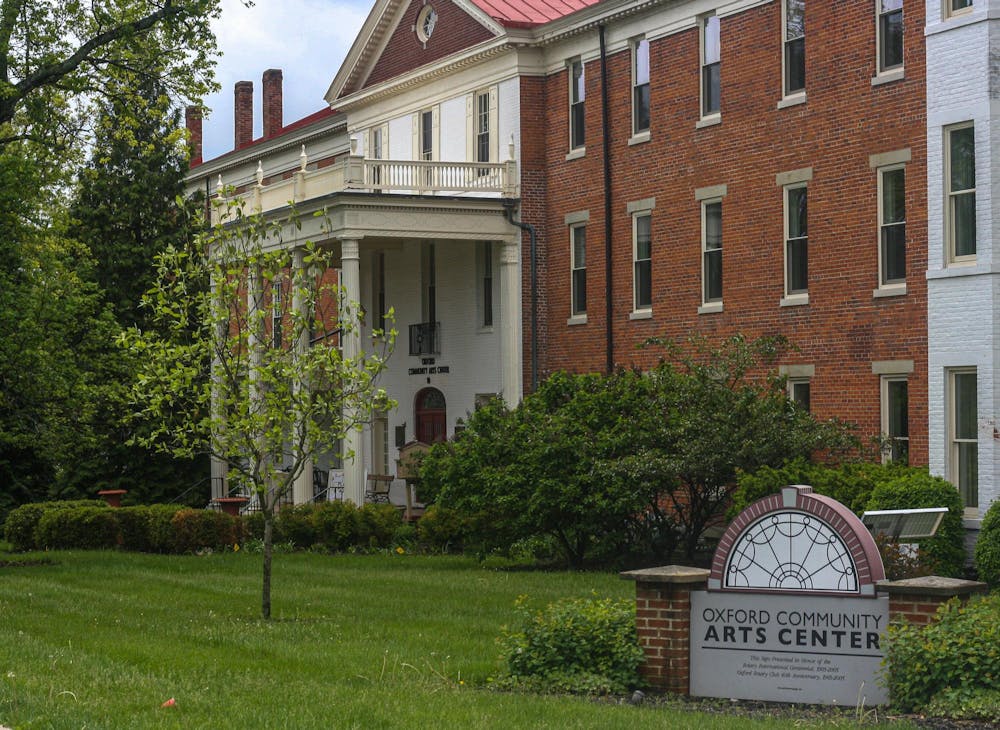
Nestled on a plot along College Street, the Oxford Community Arts Center (OCAC) has been a place where locals and Miami University students alike can go to express their love of art and creativity. Over 25 years, the OCAC has grown into an integral part of the Oxford community.
Established in 2001, the center originally had two goals: to restore the historic building and to give Oxford Area Community Theater (OxACT) a permanent home to perform in.
Long before the OCAC opened its doors, the building in which the center currently resides was home to the Oxford Female Institute. Beginning in 1849, John Witherspoon Scott, a minister and former teacher at Miami, chartered the institute. The building originally consisted of a smaller two-story building on the North side of the plot and a three-story building to the south, with a walkway connecting the two, according to the Oxford College Archives.
In 1867, the Oxford Female Institute merged with the Oxford Female College and was eventually renamed Oxford College in 1890. In 1928, Miami acquired the building and began a remodeling project that would unify “the different parts of the building with a Georgian facade,” according to the the OCAC’s website.
Up until the 1980s, Miami used the building as women’s dormitories and then as co-ed graduate student housing until 1996, when it sat empty.
That’s when a group of local actors had an idea. OxACT, at this point, had been performing for 16 years — without a permanent home. Most of their shows took place in one of Miami’s many on-campus theaters, but this became a problem when the community theater could only use the space when a student group wasn’t using it.
“You can’t schedule a season that way,” said Rebecca Howard, the current president of OxACT, as well as the president during the OCAC’s creation. “So we started kind of looking around, thinking of some other options.”
Bob Campbell, treasurer of OxACT at the time, suggested that the group take a look at Oxford College. It had a theater, a large amount of space and an interesting history. So, following the suggestion, Howard and Campbell toured the former college and saw a vision of what it could be.
“It was kind of at that point, OxACT, as an organization, said, ‘We think there’s potential here, and we will take point on this,’” Howard said. “We organized fundraisers. We contracted with an architect to do initial drawings and plans for the theater.”
Once the group had laid the groundwork, they decided that the center needed its own board that focused on all aspects of the community, not just OxACT. The founders wanted the OCAC to be a place where the community could explore their creative side.
However, the building needed to be restored first.
Over the years, volunteers and the OCAC board members have contributed to the restoration of the former Female Institute. Little by little, modern changes were implemented. Air conditioning was installed on the main floor, along with an elevator. Windows were replaced, and the kitchen was upgraded.
Enjoy what you're reading?
Signup for our newsletter
“In the first five years of the building, there was no professional staff. It was all run by volunteers,” said Heidi Schiller, executive director of the OCAC. “So those are challenges … the plaster [would be] falling, and a whole bunch of volunteers come in, and they fix the plaster. They paint, and they make this room viable, so that you can have a class and make a little money. Then you make the next room livable and viable, and then you can have another class or another event, and you get a little more money, and you continue.”
Allan Winkler, a retired history professor at Miami, took one of his classes to volunteer at the OCAC during its early years as part of their studies on the 1960s in the U.S.
“For one evening a week, for the whole semester,” Winkler said, “the whole class went in, and we chipped at the walls in the basement.”
Hours of hard work and true community support made the OCAC’s creation — and continued existence — possible.
“I will say, it has not always been a straight uphill climb, and it certainly has this little box along the road,” Schiller said. “But if you think about where we were 25 years ago, I mean, literally a hope and a prayer and a dream. We’re a half-million-dollar nonprofit organization that regionally serves 20 miles away from Oxford and beyond.”
Now, in 2026, the OCAC is home to 28 artists’ studios, an art gallery, a theater, gardens and numerous events. Also, many organizations, such as the Daughters of the American Revolution and De Fleurs Garden Club, meet at the center. The center fosters a thriving community through good times and bad.
Winkler found community in the OCAC after his wife, Sara Penhale, died in late February. While Winkler is on the center’s board, Penhale began working with other community members in 2024 to create an art exhibit, showcasing everything from ceramic mosaic pictures to detailed woodwork. After her death, Winkler and friends held a celebration of her life at the OCAC.
“About 150 people showed up for that,” Winkler said, “and it just made me feel how invested in this community we are, and how much the Community Arts Center plays a role in that investment.”
In just 25 years, the OCAC has helped 20 different nonprofit organizations around Oxford, as well as hundreds of community members, according to Schiller. In 2022, the OCAC added a clause to its contract with Miami stating that the center will not need to renew its lease until 2052.
“It has absolutely met and surpassed every vision we had that we hoped for as a community arts space in so many iterations,” Howard said.
Read More

‘Practical Magic 2’: Shenanigans
By Eliza Garrett | 2 days agoThe Owens sisters are back after nearly three decades, and this time, they have even more magic, family drama and romance than ever before. “Practical Magic 2” brings Gillian and Sally Owens back to the big screen and allows the audience to experience their magic once again.

Lizzy McAlpine makes folk her own in ‘Angel’
By Ren Chaffee | 4 days ago“Angel,” Lizzy McAlpine’s new album, released Sept. 18. Although there are some mixed reviews, “Angel” hits the mark for me.

Finding comfort in food
By August Humphrey | 6 days agoFood: possibly one of my favorite four-letter words; not just because I love a good meal, but also because of how it can represent people’s identities. Just take a quick look at the TV schedule for the Food Network, where celebrities take us into their personal lives with food. People like Ree Drummond take us behind the scenes and show us what food means to them, and the impact it’s had on their lives. Not only do we need food to live, we need it to thrive.