
I’ll be the first to admit: I am not an artist. I’ve always excelled in the sciences, focusing more on logic than creativity in my education and career. However, opposites attract, a phenomenon best proved by my years-long friendship with fellow Miami University student Alli Bumby, a senior studio art and art therapy double major with creativity to spare.
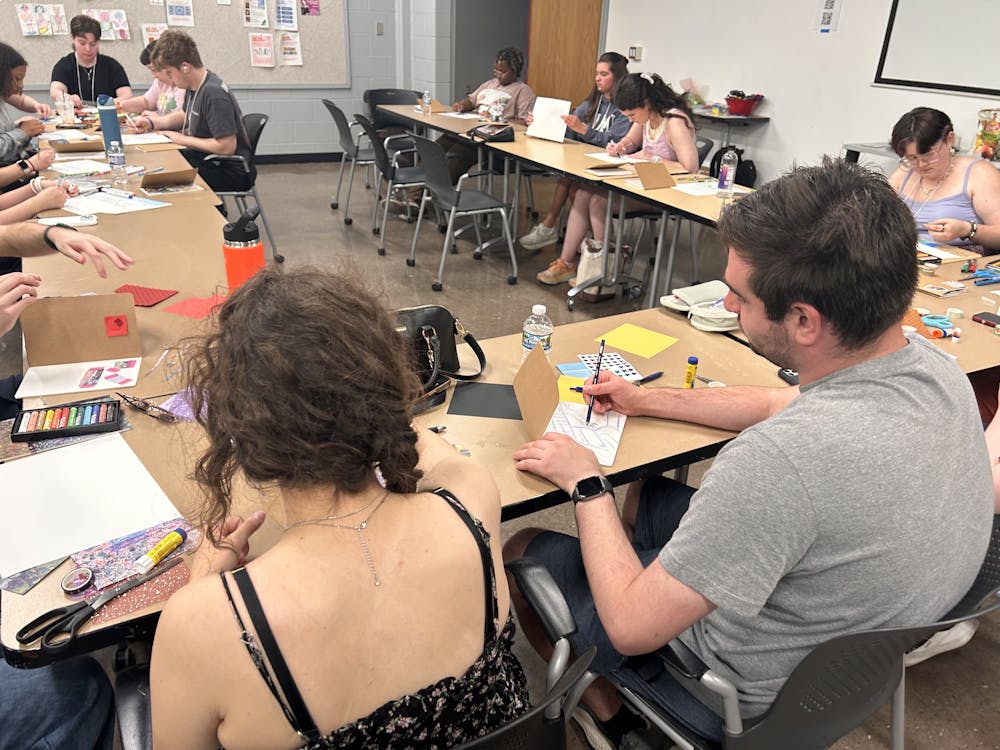
Bumby invited me to the Department of Art’s inaugural Art and Wellness Day on April 12, a first-of-its-kind event featuring workshops, group art-making activities and a guest presentation from licensed art therapist Jen McHale.
Before the event, I thought I had a good idea of what art therapy was: patient-led art creation within a typical talk therapy format. But as the day progressed and I had the opportunity to discuss what it truly is — and perhaps more importantly, what it is not — I came to understand that my preconceptions about this branch of psychology didn’t even scratch the surface.
When considering what sets art therapy apart from traditional talk therapy, other than the obvious addition of an artistic medium, Bumby clarified one of the biggest misconceptions straight away.
“The biggest preface of it all is it’s never art therapy unless there’s an art therapist present,” Bumby said. “You can do lots of therapeutic art making and art has inherent therapeutic value, but unless there’s a licensed professional, it’s not art therapy.”
The distinction between art therapy and therapeutic art making was put into practice as I participated in two workshops led by Miami art students focusing on physical media making.
The first explored watercolor painting and how combining watercolor with acrylic paint adds dimension to an artwork. After half an hour, I felt myself slipping into defeat. Most of the students I sat with were in the creative arts and worked with the colors and brushes on a level I could only ever dream of. Their almost intrinsic understanding of the materials dazzled me, but it also left me deflated.
This feeling of not being “good enough” at art to enjoy the process is common among people experimenting with therapeutic art for the first time, as they often have high expectations for themselves and feel a strong desire to “succeed,” according to the International Journal of Art Therapy. That instinct, however, is antithetical to the incredible benefits.
When I expressed my frustrations to her, Bumby instantly validated and encouraged me.
“With art therapy, it’s not about learning technical skills, but understanding the material is enough,” Bumby said.
Bumby highlighted the practice’s approachability as well as its uniqueness.
“It’s a way more body-driven experience as opposed to staying in your mind, and that’s kind of what I think is uncomfortable for a lot of people with therapy,” Bumby said. “I also think that it kind of has this subconscious ability for you to recognize, to kind of hunt down or find issues that you didn’t even know you maybe wanted to talk about.”
Enjoy what you're reading?
Signup for our newsletter
The subconscious exploration one experiences through therapeutic art manifested in real time, as I transitioned from the first workshop to the second, which worked with chalk pastels.
Upon first laying pastel to paper, I immediately felt a difference in the way I reacted to these new materials in comparison to the watercolors I was using not even an hour before. I found the malleable yet hardened quality of the chalk allowed a greater freedom of expression within me, and after the workshop concluded, I wished I could have stayed hours longer, exploring all of the colors and textures the pastels provided.
The clarity I felt within me echoed a sentiment that Bumby thinks sits at the core of art therapy and therapeutic art making.
“It’s really cool to have people having hands-on experience of understanding how good it can feel to use art materials, even just for 10 to 30 minutes,” Bumby said.
Art and Wellness Day is in its infancy, but Bumby has high hopes for what the future of this event holds and what it could become.
“I hope people leave with a strong understanding of what exactly art therapy is, as opposed to just playing with materials,” Bumby said. “It’s a real profession, and it’s really important work.”
Entering the day was daunting, but after the few hours I spent learning more about the field, I came to realize that if you allow yourself to fully experience the benefits of an incredible journey through therapeutic art making and art therapy, there’s no limit to what you can glean from this practice. Bumby put it best:
“This is just level one.”
Emily Burns is a junior Opinion writer for The Miami Student who is majoring in environmental earth science. Outside of the newspaper, she competes in ice dance for the Miami University Figure Skating team.
Read More

Lizzy McAlpine makes folk her own in ‘Angel’
By Ren Chaffee | Yesterday“Angel,” Lizzy McAlpine’s new album, released Sept. 18. Although there are some mixed reviews, “Angel” hits the mark for me.

Recap: McComb shines in 24-21 thriller against UConn
By Graham Young | 2 days agoOn Sept. 26, 2026, the Miami University RedHawks met their next competitive match of the regular season.

Miami football adapts to NIL era
By Colin McDonald | 3 days agoAs Miami continues to increase its investment in football, the RedHawks will have to prove that their new approach to NIL can keep them competitive without becoming financially unsustainable in the coming years.