
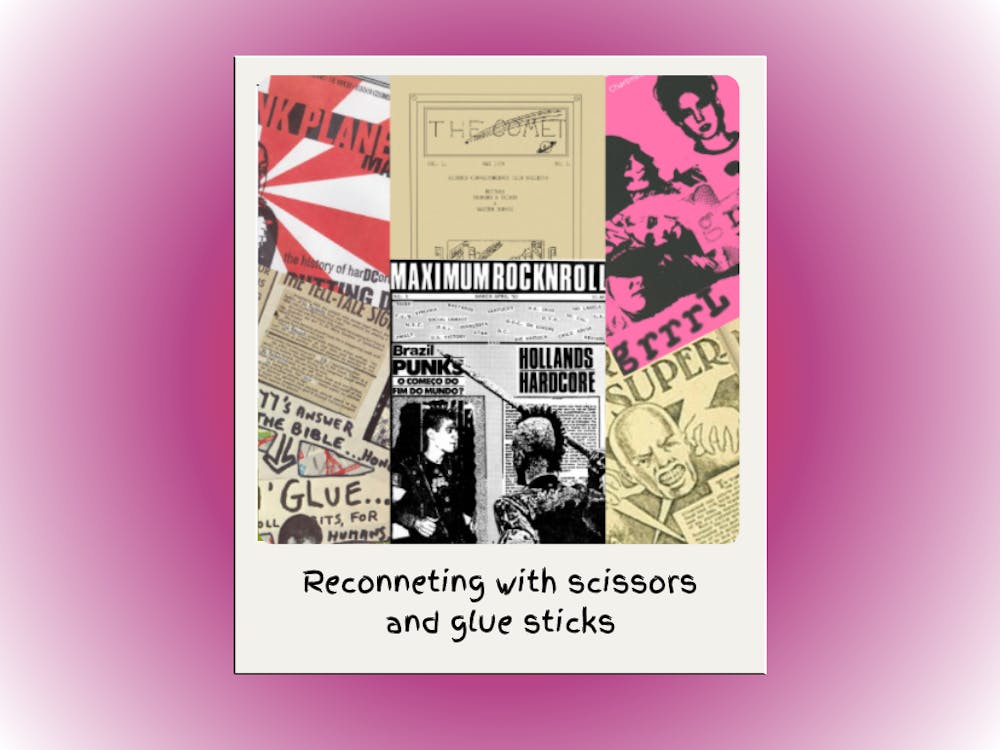
Sticky fingers, paper clippings and ink smears are the fundamentals of zines. While this may sound juvenile, this accessible entrance to a nuanced community is a huge part of the appeal. Anyone can do it, any time.
Stefanie Hilles, a librarian at the Art and Architecture Library, defined zines as “self-published, kind of anti-establishment, underground little magazines that, in a lot of ways, are done for the love of the game instead of profit.”
Professor of creative writing, Margaret Luongo, said that zines are a well-loved and important art form.
“There’s something really beautiful about physically handing someone something you made,” Luongo said. “The most complicated things you need are scissors and glue sticks.”
With zines, you can simply sit down and make something; the process doesn’t take a lot of planning, just a bit of creativity. Because of the freedom from the constraints of having to appeal to big publishing houses, zines can become your creative domain.
“If you’re Gen X, you basically raised yourself, and the zine is very conducive to not needing special things,” Luongo said. “You could be at home by yourself and use whatever you had around you.”
Hilles said the “very medium is based on taking something that’s already there and creating a new meaning for it.” It is similar to collaging, but generally incorporates text alongside the images.
Zines originated in the 1930s with a science fiction fanzine “The Comet,” according to The People’s Graphic Design Archive.
From there, zines expanded outwards, capturing different genres like perzines, informational zines, political zines, DIY instructions and more.
A few examples of more well-known zines include “Sniffin’ Glue,” “Maximum Rockwell” and “Punk Planet.”
Hilles said one of her favorite zines is the “Dystopian Auto Trader,” which takes the original “Auto Trader” magazine format and subverts it as a way to create humor out of the design.
Different sub-genres of zines can have defining features. For example, punk zines use heavy, chunky and bold handwriting, usually with Sharpies, and photocopy the same zine over and over again to create a grainy effect, according to Hilles.
Enjoy what you're reading?
Signup for our newsletter
Visual aesthetics and images add layers to zines that would not be possible with just words. The combining of largely different mediums opens a whole new area for creation.
“The image from the Sex Pistols is a good example of where there were some really deliberate choices that affect the viewer on the subconscious level,” Luongo said. “If you recognize those cues like the ransom note, it can really affect us viscerally. It’s operating outside of logic. I mean, then you can logically take it apart and examine how it’s creating the effect.”
The different aesthetics of zines have evolved as new technologies emerge. At the same time, different aesthetics from different eras and counter-culture movements arise.
Zines have even made it into the online space in ways like collages. Digital collages are a form of virtual art where you combine images, textures and utilize digital tools to arrange them. Physical zines continue to persist in the current digitally dependent climate.
However, seeing art in three dimensions is completely different.
“The first time I ever saw Mondrian painting in person, I was completely shocked that you could see the little brush strokes,” Luongo said.
Mondrian paintings are famous for their thick brush strokes. These brush strokes appear flat in images online but when seen in person, they have a 3D quality to them that is not available digitally.
Fourth-year creative writing and history double major Marlow Zuch briefly worked with cataloging zines in the Art and Architecture Library. Zuch, who uses the pronoun they, said their favorite era for zines is the 1990s, because they’ve worked with those a lot.
“There’s absolutely no standard for zine making, and it’s great,” Zuch said.
For those new to zines, Zuch recommends thinking of a theme. Looking for aesthetic images that fit that theme and color palette will allow the zine to flourish.
“Dive in and just do it,” Hilles said. “Zines don’t have to be perfect. In fact, they’re not even supposed to be perfect; they’re intentionally imperfect.”
chaffele@miamioh.edu
Read More


Board of Trustees adopts 2027 budget, approves funding for FSB project
By Shannon Mahoney | July 1, 2026The Miami University Board of Trustees approved the fiscal year 2027 budget and heard presentations on MiamiTHRIVE and athletics at their June 26 meeting. The board also authorized the creation of the Cleveland Clinic president’s fund, which would be used partially to fund the joint quantum computing initiative with the Cleveland Clinic.
College students should be taught by human professors, not AI
By Elena Jackson Albarrán , Cathy Wagner and Theresa Kulbaga | June 12, 2026"The Faculty Alliance of Miami (FAM), the union representing nearly 800 full-time continuing faculty and librarians, is fighting for reasonable protections, including a stipulation that faculty cannot be replaced by AI. The administration is refusing to agree even to these minimal protections."