
The views expressed in this article are solely those of the author and do not reflect the views of the U.S. Environmental Protection Agency, the City of Oxford or Miami University.
When I first arrived at Miami University as a student, I remember walking across campus one autumn day and noticing strange lime-green balls scattered on the ground that looked like oversized oranges. I had no idea what they were. Where I grew up in northeast Ohio, I had never seen an Osage orange tree, despite hiking and cross-country skiing in the woods.
I still remember kicking those fruits as I walked to my class. Because they were unfamiliar and distinctly local, they became one of my first uniquely “Miami” impressions. Even now, whenever I see those same fruits in the fall — often as road hazards on my daily bike rides — I am transported back to those first days on campus.
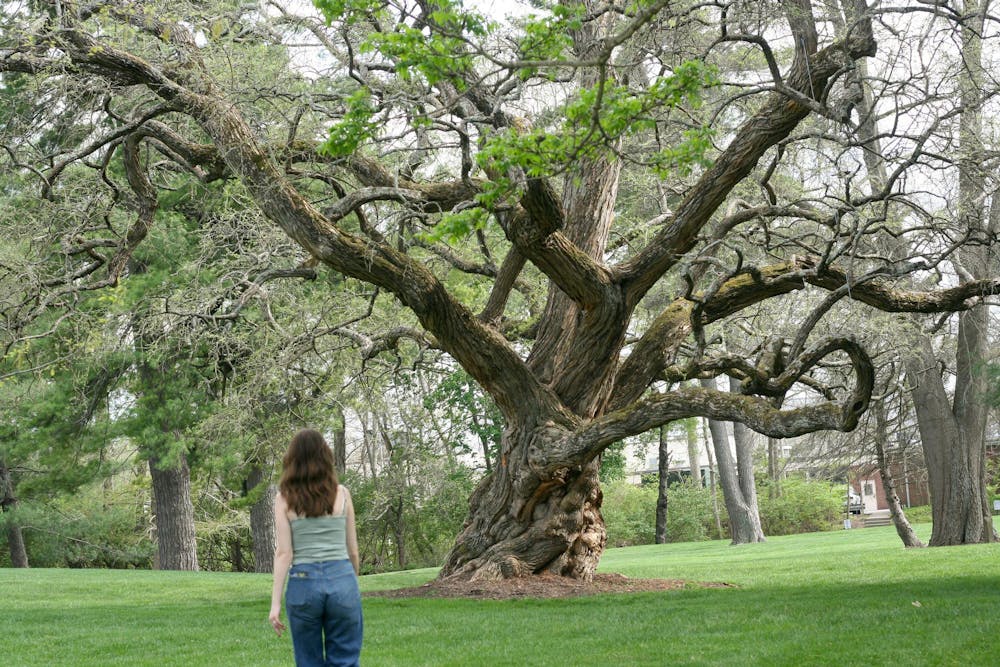
What I did not realize then, was that some of those trees had been standing for generations. One notable specimen stands behind Cook Field. With a circumference of 234 inches, the tree may predate the founding of the university. For more than two centuries, it has witnessed the transformation of Miami’s campus, its long horizontal branches stretching outward to link “Old Miami” to the modern university.
That tree now sits within the footprint of the proposed new basketball arena. It is easy to describe the benefits of such a project in economic terms — revenue, facilities and visibility. The costs from an environmental perspective are much harder to quantify. This imbalance reflects a broader limitation in how society and the law understand environmental harm.
Our legal system is designed to protect human interests, particularly those easily expressed in economic terms. Courts are well-equipped to evaluate harms like property damage or lost income, because markets provide a way to assign value. Environmental harms are different. Nature often provides benefits that cannot be reduced to dollars and cents, and the law generally does not recognize those benefits unless tied to human use.
Consider a polluted river. If contamination destroys a fishery, a commercial fisherman may recover lost income. But if no one depends on that river economically, the law struggles to account for the loss. The harm to the river itself, the species that inhabit it or the broader ecosystem is largely invisible. However, the problem is not simply one of measurement; it is one of recognition.
This is the dilemma posed by the Osage orange tree near Cook Field. Because the university owns it, its fate will be decided based on Miami’s priorities. So long as its removal does not produce a legally recognized economic harm to the university, the tree has no independent claim to continued existence. That conclusion may seem like common sense. Trees cannot appear in court or assert rights on their own behalf. Or can they?
In the 1970s, legal scholar Christopher Stone argued that rivers, forests, and ecosystems might be recognized as having legal standing to sue in court on their own behalf. The idea was embraced by Justice William O. Douglas in a dissent in a famous Supreme Court case, and has since been adopted in countries like Ecuador and New Zealand, where rivers and ecosystems have been granted legal rights.
At first glance, this may seem like a radical departure from traditional thinking, but the law already recognizes non-human entities like corporations as legal persons. Corporations are not living, breathing human beings, but act through human representatives who articulate their interests in court. Extending a similar framework to natural objects would not require inventing a new concept so much as adapting an existing one.
The ancient Osage orange tree illustrates the limits of our current approach. Its worth is not primarily economic but historical, ecological and symbolic as an unbroken thread linking generations of students and the landscape they inhabited. If the tree succumbs to the developer’s axe, its loss could not be meaningfully replaced by planting new trees elsewhere. A 200-year-old organism is not interchangeable with a collection of seedlings. Its importance lies in continuity through time and stored ecological value.
This perspective echoes renowned conservationist Aldo Leopold’s “land ethic,” which expands the moral community to include soils, waters, plants and animals. Under this view, humans are members of a broader ecological community, with corresponding responsibilities. The landscapes we inherit are the product of time and stewardship, and they cannot be recreated once lost.
Enjoy what you're reading?
Signup for our newsletter
None of this means that development is inherently wrong. Universities evolve, and new facilities are often necessary. But decisions like this invite closer scrutiny of the standards we use to guide sustainable change. While Miami may have no legal obligation to preserve the tree, legal rules establish the minimum requirements, not moral or aspirational goals.
At Auburn University, when historic oak trees were poisoned by a rival Alabama fan, the act was condemned as an attack on the university’s identity. Here, a comparable loss would not be an act of vandalism, but the result of deliberate, institutional decision-making. Although Miami’s decision will be made in good-faith, the loss of the tree would be permanent.
The law is an important tool, but not the sole measure of what should be done. Environmental law persistently trails advances in scientific understanding and evolving ethical values. Institutions like Miami are designed to engage new ideas and reconsider established assumptions. Asking whether a tree should be protected is not merely a legal question; it is a way of examining what we value as a community. This is especially true when Miami promotes sustainability as a core value.
The Osage orange tree near Cook Field cannot speak for itself. But its presence raises a question that extends beyond any single project: How should we weigh the claims of the past against the demands of the future? How do we place value on a living museum compared to a few additional asphalt parking spaces? Some losses, once made, cannot be undone. That alone may be reason enough to pause before deciding its fate.
Read More

The myth of feeling ready
By Kathryn Hippe | Yesterday"I used to think of life as a blank sheet of paper — patiently, it waited for me to fill it, but the first word hung hesitantly on the tip of my pen. I tore out the page, crumpled it into my palm and began again."


The bond behind Blake Mesenburg’s Teammate of the Year finalist selection
By Graham Young | 3 days agoBlake Mesenburg and Liam Jergenson have formed an incredible bond through Team IMPACT and the Miami University RedHawks hockey team.