
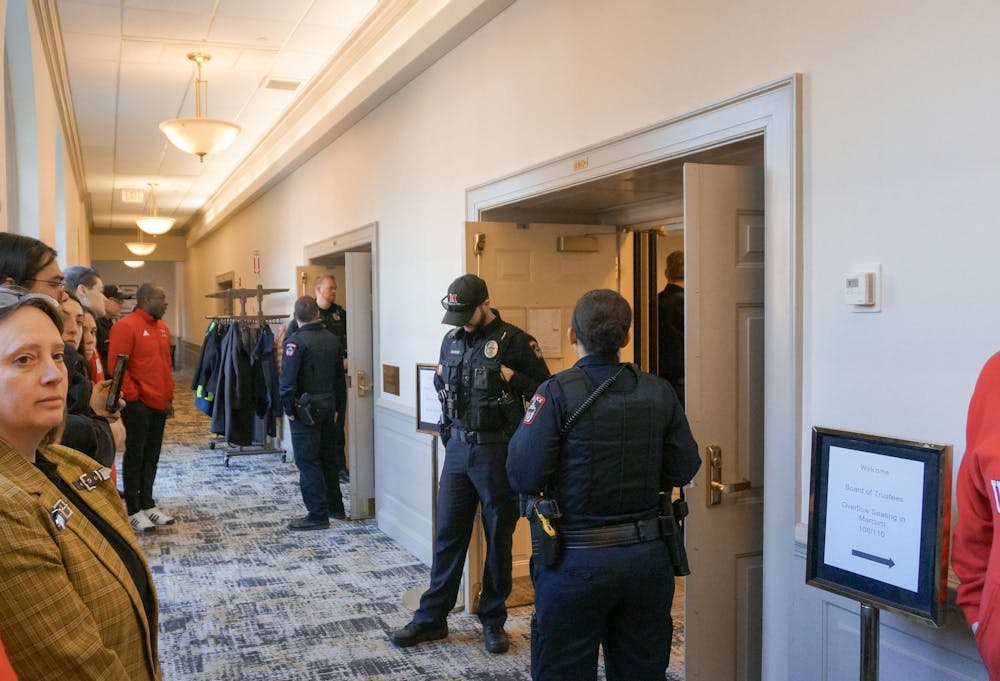
At 8:45 a.m. on a brisk February morning, students and faculty lined the hallway of the Marcum Hotel and Conference Center. Organized by the Faculty Alliance of Miami, the Ohio Student Association (OSA) and the Young Democratic Socialists of America (YDSA), we assembled at the Board of Trustees meeting to oppose a motion that would take out $281 million in debt to develop a new stadium on top of Cook Field.
Despite a survey finding 89% of students and other stakeholders opposed the project, it looked like the board would move forward with the development. We wanted to make our opposition clear.
As we arrived, we were turned back at the door by campus police, who said they were out of seating, which looked to have been reduced since the last meeting. I watched through the doorway over the shoulders of cops and administrators as my peers, who had gotten the few three-minute speaking slots, argued their perspective.
Students, who organized around this issue for months and conducted a survey with over 3,000 respondents, were given only three minutes to address the board. Then, I watched as students and athletic staff in favor of the arena were given over two hours to speak.
The truth is blatantly obvious: those speaking on behalf of the vast majority of students were barely allowed to enter the room because their opinions and voices were not valued.
The vote to take out the new debt and remove Cook Field passed unanimously. This is just one example of the disregard the people with power at our public university have for the opinions of students and faculty.
They are destroying the Miami Plan, despite artificial intelligence making it more important for students now than ever. They removed the safe space in the Armstrong Student Center for marginalized groups and tore down flags supporting them.
They are consolidating and removing majors that they deem to have “low enrollment,” a nebulous classification that now includes my major — creative writing — the most popular in the English department.
So why is Miami University doing this? They claim these decisions are financial and based on changing student priorities. But if this were true, they wouldn’t be voting to take out millions in debt for an arena that 89% of people don't want.
The few people in charge continue to demonstrate a clear conservative bias and, at times, a seeming disdain for higher education as a whole.
Ohio Senate Bill 1 removed a significant amount of the University Senate’s power and granted the Board of Trustees final, overriding authority over their decisions. While the individual administration members I’ve spoken with all seem to care about the liberal arts education of Miami students, I fear their judgment is clouded by a desire to appeal to the short-term market forces and current state and federal government officials.
This leaves near total control of the university with the Board of Trustees, an unelected 17-member group containing no faculty, two non-voting students and 11 members appointed directly by Ohio’s conservative governor Mike DeWine.
Enjoy what you're reading?
Signup for our newsletter
Unless the student body says otherwise.
A month before the Board of Trustees meeting, hundreds of Miami students assembled at the seal in sub-20-degree temperatures to protest the university’s silence on Immigration and Customs Enforcement (ICE). Organized by a coalition of student organizations, including OSA, the College Democrats and YDSA, a large group gathered to make clear that a campus that isn't safe for all students isn't safe for any students.
Marching through the cold at the January ICE OUT protest, the air was filled not just with flurries of snow but with a sense of solidarity, purpose and power. I felt the same solidarity at the Board of Trustees meeting, as I attended the YDSA national organizing conference in Chicago this February and at the No Kings protests I saw in Oxford, Cincinnati and Seattle last year.
Young people working in solidarity have the power to overturn systems of oppression and shape the institutions and world they want to live in.
After the protest and pressure from an ongoing YDSA petition, the administration met with OSA to discuss concessions like using the university alert system to inform students of ICE activity on campus.
This is not enough. We need the university to fully block ICE from entering campus without a judicial warrant and ensure it is a safe place for all students. We need them to cancel all plans to waste our money building the new arena.
But their concessions prove that we students, working together, have the power to shape our future, here on campus and beyond.
If you, too, feel like no one is listening to you, join us. Together, even forced to stand in the cold and outside rooms of power, we will be too loud to ignore.
Abe Hagood is a first-year student double majoring in creative writing and emerging technology in business and design. He is the assistant Opinion editor for The Student, a steering member of the Miami University Young Democratic Socialists of America and a leadership member of the Game Design Club.
Read More
Growing concerns around a new synthetic opioid cychlorphine
By Tori Fee | 14 hours agoCychlorphine, a strong synthetic opioid, has become a growing concern in at least 24 states, including Ohio. Recent overdose cases at college campuses across the nation are putting a spotlight on cychlorphine and its risks.

Alcoholic beverages lack transparency and oversight
By Elisa Rosenthal | Yesterday"The back of the can doesn’t give much information either, only a government warning and a select few nutritional facts: calories, carbohydrates, protein and fat. Although I’m sure that’s enough for some — and too much for others — it lacks transparency."

Oxford listened to the community and terminated its Flock Safety contract
By Charley Babb | 2 days ago"The issue with Flock isn’t the arrogant name brand, nor is it just the critical security flaws in every aspect of their system. The real issue with Flock is the fact that it allows warrantless tracking of citizens, for no other reason than the whim of a police officer."