
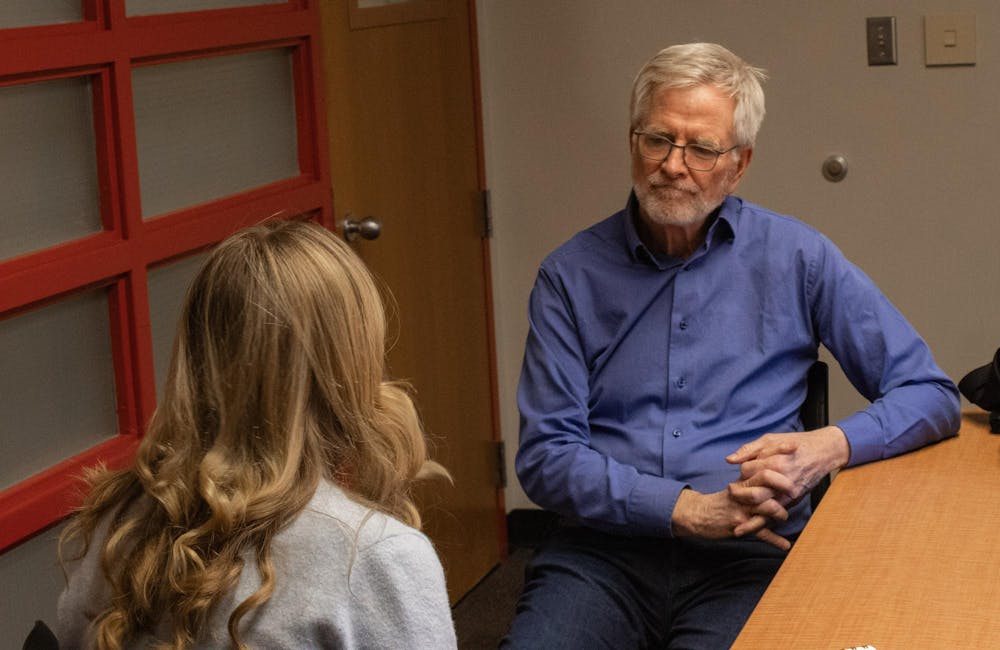
Prior to his lecture in a packed Harry T. Wilks Theater, Rick Steves sat down with The Miami Student in a humble Williams Hall conference room – professional writer to student journalist.
Rick Steves, television host, best-selling author, activist and teacher, visited Miami University for the university lecture series as part of his mission to encourage Americans to broaden their perspectives through travel.
Questions and answers have been edited for concision and clarity.
What is your favorite song right now?
It’s not an obvious first question to ask a traveler, but Steves is also an accomplished pianist and music enthusiast. He had just jumped off the plane from his Europe: A Symphonic Journey performance in Buffalo, New York, before arriving in Oxford, Ohio.
Steves’ song of choice right now is “What The Hell Is Going On?” by Elvin Bishop. It is a funky anti-authoritarian song with sparse lyrics, but it carries a pointed political message depicting the shape of a nation under political extremes.
Enjoy what you're reading?
Signup for our newsletter
An outspoken activist, Steves wrote Travel as a Political Act. In part one, he encouraged readers to travel like medieval court jesters, saying they were in a unique position to tell the truth to those in power.
Steves wrote that he believes any traveler can play a jester in their own community by returning home with valuable insights. Naturally, his song choice led to the following question.
How do you recommend that we, as a newer generation, trailblaze better relationships with different people and play jesters for our communities?
If people are afraid of women having authority in a church, a gay person in their family or some other culture, Steves said, they’re probably afraid because they do not understand.
“I think the trick is, are you willing to speak truth to power, even in your own social circles and your own families. Can you lovingly challenge people to get out of their preconceptions and open their mind,” Steves said. “You don’t want to just ruin a nice family dinner. Sometimes somebody has to speak up, and my challenge is to expect a lot out of people without abusing the bully pulpit.”
Steve said when he acts as a tour guide, he doesn’t just hit people in the head with his ideas while the doors are locked and he wields the microphone. People open up through experiences and the ability to make their own decisions about ideas.
“They’re probably afraid of it because they don’t know it,” Steves said, “so if you can help people get to know each other, the understanding takes over.”
What advice do you have to encourage Miami students to get involved and give back – whether it is during study abroad or a normal day?
Along with advocating for playing the role of a ‘jester,' Steves has also encouraged Americans to become ‘temporary locals.’ While not all students are able to study abroad, they can still be active locally.
“Good societies don’t just happen. They happen when good, caring people do more than their share,” Steves said. “So if you really want to be a good citizen, if you want to make a better world, get involved. Make a difference.”
Are students able to take lessons away from your lectures even if they aren’t traveling abroad?
The lecture was designed to encourage Americans to get out of their comfort zones, Steves said, to be transformed by culture shock.
“It’s easier if you can fly to Egypt or Morocco, but you can do that without even leaving this country,” Steves said. “You just need to be curious about the world and not be judgemental about the world and not be afraid of the world.”
What do you have to say to anyone who’s fearful of getting out of their comfort zone?
Steves said with a society that is politically polarized right now, people are often fearful. He shared his own message about fear in the face of travel.
“Fear is for people who don’t get out very much,” he said “The flip side of fear is understanding, and when you get out, you understand. I just think there’s a lot of fear in our society. But [Roosevelt] said ‘the only thing we have to fear is fear itself,’ and I think that is so wise. I’m tired of hearing people say have a safe trip. Say bon voyage, have a good trip.”
Read More

Miami’s ‘AI in the Majors’ initiative to begin integration
By Liam Clarke | 3 hours agoThe “AI in the Majors” initiative at Miami University will integrate artificial intelligence (AI) teachings into 13 departments this fall. Additionally, two new minors, courses and a degree centered around AI will be available for students to gain AI capabilities catered to their field of study.
Things I wish I knew my first year of college
By Elise Hanna | 6 hours ago"As a now-sophomore, I consider my first-year experience to be one of the most influential times of my life, and I genuinely wouldn’t change it for the world."

Letter From the Editor: The power of speech
By Shannon Mahoney | Yesterday"During my time at Miami University, the most important thing I’ve learned is the importance of speaking up. The transition to college can feel insurmountable, especially in a sea of thousands of students, but it gets a lot less scary if you remember to extend a simple, 'Hi.'"