
This column was originally published by the Oxford Free Press on Feb. 20.
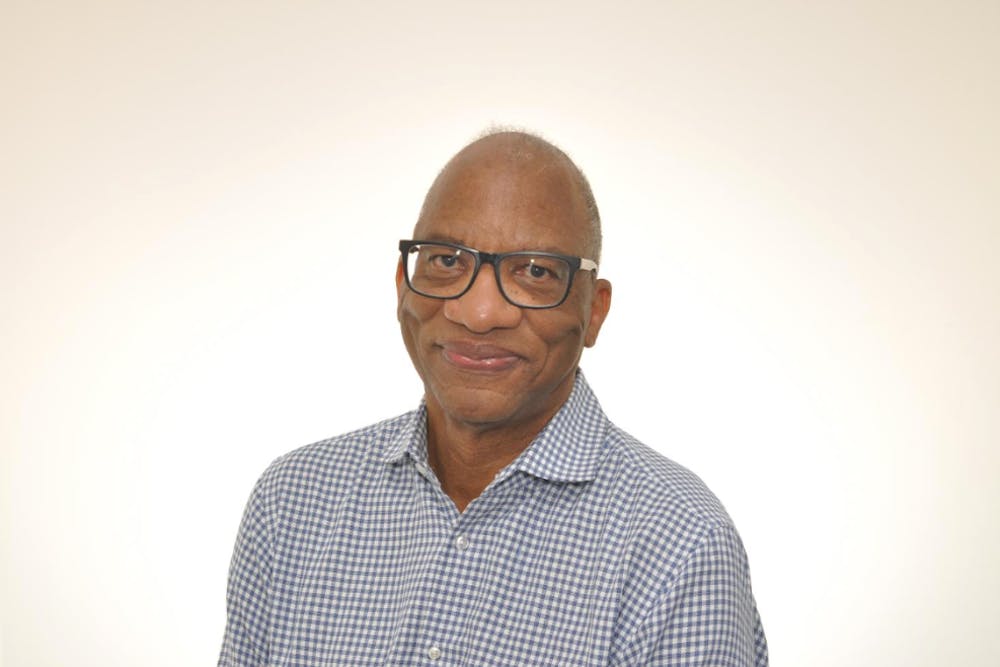
Wil Haygood is a traveler, a storyteller. Apparently, he is also dangerous.
His 10th book, “Colorization,” a history of Black films and filmmakers, was temporarily banned last year from the Naval Academy library by the Trump administration. Someone thought that stories of our American history might harm future sailors.
His 11th book, “A War Within a War: The Black Struggle in Vietnam and At Home,” was published earlier this year. In his New York Times review, Brent Staples writes: “Haygood’s earlier books, including biographies of Sammy Davis Jr. and Adam Clayton Powell Jr., earned him a reputation as a temperate and perceptive social historian. He maintains his characteristic low-key tone as he explains why the full picture of Black Vietnam went unseen by most Americans: the white press corps was uninterested in questions of how race and racism were shaping the Blackest war in our national history.”
“A lot of people didn’t know the social commentary that was the backdrop behind the war,” Haygood said. “Black soldiers lived in the shadow of legal segregation in the Jim Crow South. They were fighting a war for America, and they didn’t even have full rights legally until the Civil Right Acts were passed in 1964, 1965 and 1968. And after the war, the laws weren’t fully enforced. Southern states paid little attention to these laws. Black soldiers were fighting to defend their country, but back home, Mom and Dad were still not allowed to vote.”
I first met Haygood, a 1976 Miami University graduate, in spring 2013. He delivered Miami’s commencement address, beginning his talk with the trailer for “The Butler.” This 2013 Hollywood movie was based on a story he had written as a reporter for the Washington Post in 2008. Wil had found a Black butler, Eugene Allen, who had worked for eight presidents. The story ran two days after our first Black president was elected. That led to his bestselling book, “The Butler: A Witness to History,” and to the award-winning film, starring Forest Whitaker and Oprah Winfrey. Thanks to Haygood, Whitaker was Miami’s 2014 commencement speaker.
After that 2013 commencement, I asked Haygood if he would be interested in teaching at his alma mater. He joined the new Media, Journalism and Film Department, which I chaired at the time, and has since served as a scholar-in-residence at Miami, teaching, speaking and mentoring. He helped two former students, Reis Thebault and Emily Williams — both former editors of The Miami Student — land internships at the Boston Globe, where Haygood had worked for 17 years. Reis is now a national correspondent for the New York Times.
“I was starstruck when I first met him,” Thebault said in an email. “But what’s less known is his generosity as a mentor. When I was a young journalist, I always knew I could call him up, ask his advice and get a thoughtful answer, studded with anecdotes from his work across America and around the world. He had faith in me, and that confidence propelled my career.”
Williams is now a podcast producer at CNN, currently working on the show “All There Is with Anderson Cooper.”
“Having Wil Haygood as a professor was a highlight of my journalism education at Miami,” Williams said in an email. “I admired his work so much, and his feedback and encouragement to me as a student held significant weight. I’m always so grateful to hear from him and excited when he has a new book out to read!”
Haygood served as Miami’s 2018 convocation speaker, focusing on his book “Tigerland,” which tells the stories of the East Columbus High School basketball and baseball teams that won Ohio state championships in the 1968-69 school year — in the shadow of Martin Luther King’s assassination.
A teacher at a Columbus, Ohio high school planted the seeds of his writing career. It was 1972, his senior year at Franklin Heights.
Enjoy what you're reading?
Signup for our newsletter
“There was an essay assignment, and the teacher handed back papers and stopped to share with the class that I had written the best paper,” Haygood said. “I was stunned that anybody would take the time to say something that good. So when I went to Miami, I had the wind at my back.”
The winds shifted, and Haygood struggled at Miami, starting out as a business major. But after an economics class went sideways, he started taking English classes. As he recounts in his first book, “The Haygoods of Columbus,” published in 1984, he switched to an urban studies major, minoring in English.
“I wanted to be somebody moving about in the world,” Haygood said. “Urban studies seemed to say that I could find a job in any big city.”
Haygood’s urban studies major was the inspiration behind that first book — about the Mt. Vernon Street neighborhood where he grew up and where tanks roamed during the urban unrest of the late 1960s. By that time, he had worked a series of reporting jobs in Pittsburgh, Boston and Charleston, West Virginia, where colleagues told him he should write longer pieces — even books.
After a feature piece in the Boston Globe’s Sunday magazine on a trip down the Mississippi celebrating Mark Twain’s 150th anniversary, an editor from the Atlantic Monthly Press called. He told Haygood, “You have the skills to write books.” So he did.
Haygood’s books are not produced quickly. He is a meticulous researcher and constant traveler — a “solo voyager,” he likes to say. He needs four to five years to produce each book. All that shoe leather and commitment leads to excellence and recognition.
As a traveler, Haygood has reported from France, Germany and India. In South Africa, he wrote about Nelson Mandela’s liberation from prison, and in Somalia, he was kidnapped and then ransomed by rebels. In addition to Pulitzer Prize nominations as a reporter, his books have earned multiple honors, including Guggenheim and National Endowment for the Humanities fellowships. In 2022, acknowledging the long arc of his work, the Dayton Literary Peace Prize honored him with the Richard C. Holbrooke Distinguished Achievement Award.
Haygood’s books are about American history. “Black souls,” he says, are at the center of the tapestry of this country.
“Without Frederick Douglas, Ida B. Wells, Thurgood Marshall, Sidney Poitier, Duke Ellington, Louis Armstrong, Harry Belafonte, Toni Morrison, Alice Walker, Oprah Winfrey and so many more,” Haygood said, “you do not have the full fabric of America, the mosaic that has become America.”
Richard Campbell is a professor emeritus and founding chair of the Department of Media, Journalism and Film at Miami University. He is also a co-founder of the Oxford Free Press.
Read More

Law schools must do more to help students choose a specialty
By Arush Chandna | Yesterday“Internal and holistic guidance can help students choose beyond just financial outcomes.”

Living faithfully in a season of waiting
By Maria Valentina Almeida | Yesterday"Through this experience, I have learned that suffering is not merely an obstacle to overcome, but an invitation to deeper union with Christ. I have accepted this chapter as one filled with purpose."
‘Yes’ can be a life-changing word
By Raquel Hirsch | 5 days ago"Seeing my name in print for the first time filled me with a sense of confidence I had been missing. I felt like this was something I could be good at, surrounded by people who shared the same values that I had."