
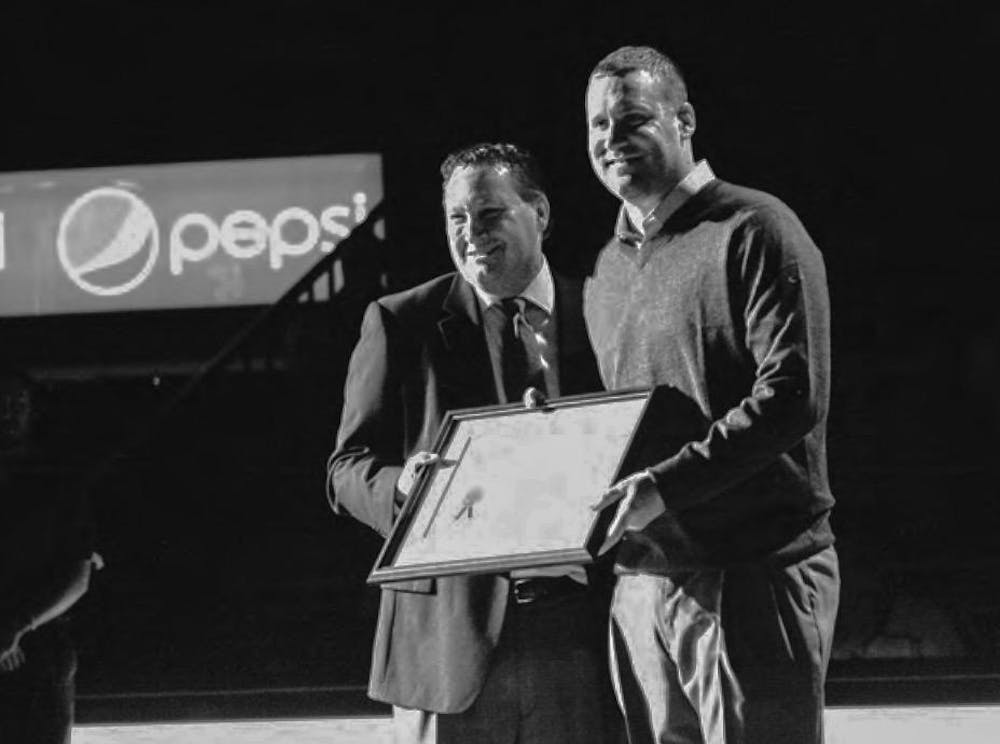
The Miami University athletic department is in the midst of a resurgence.
The RedHawks have the most wins in Mid-American Conference (MAC) football history, the most wins in MAC men’s basketball history and they have won numerous Reese and Jacoby Trophies for all-sport success in the MAC. Many will look at this success and rightfully credit the student-athletes and the coaches. But that doesn’t tell the whole story.
When David Sayler was hired as director of athletics in January 2013, he immediately transformed Miami into one of the best and most well-rounded athletic departments in the MAC. The department won the Cartwright Award, voted on by other conference athletic directors, three-straight years from 2018-21.
Sayler grew up in Dayton and has always been familiar with Miami, crediting Ron Harper for his love for the university.
Sayler has had an immensely successful career over the course of his 13 years at the university. He does not pick favorites when it comes to sports, but he points to all-sport success as one of his greatest achievements.
“Winning all-sports trophies really matters to me because it’s symbolic of the success that all our teams are having collectively,” Sayler said. “We celebrate all of our championships the same, and we’ve won 80 during my time here.”
Sayler put Miami on the national stage in recent years. In 2023, he was selected to the College Football Playoff Selection Committee, becoming the first MAC athletic director to do so.
Perhaps the most impressive accomplishment of Sayler’s tenure is the Graduating Champions initiative. The campaign raised more than $82 million and helped to build the Gunlock Family Athletic Performance Center.
“It is critical to get the donor's support,” Sayler said. “We need to show the university that we can bring revenue into the program. Donor cultivation is critical to the lifeblood of everything that we do. We’ve raised over $200 million in my time here in total, and almost all of that is from alumni.”
Sayler’s work is far from done at Miami. He eyes further success and improvements in the athletic department. The Arena District is next on the docket, along with continuing a high level of success in other areas.
But Sayler is not the first athletic director to show the world what Miami has to offer. Bo Schembechler, a member of the Cradle of Coaches, coached the RedHawks football team for six seasons. He was hired by John Brickels, the athletic director from 1949-64. He also served as head basketball coach during his time as athletic director.
Immediately following Brickels was Richard (Dick) Shrider. Shrider served as athletic director from 1964-88 and oversaw the inclusion of women’s sports at the university. He also saw the varsity programs grow to 11 for men and eight for women. Most notably, Shrider oversaw the construction of Millett Hall and Yager Stadium during his tenure, both of which remain active facilities today.
Enjoy what you're reading?
Signup for our newsletter
Prior to his time as athletic director, Shrider was the RedHawks' head basketball coach. In 1958, he led the team to an undefeated MAC record, and that squad was the first MAC team to ever win an NCAA tournament game.
Brad Bates took over as athletic director in 2002 and played an instrumental role in keeping Miami’s athletic tradition. Bates was responsible for building a new softball field, renovating the field hockey field and constructing the Goggin Ice Center, including the Steve Cady Arena.
Collegiate sports have undergone many renovations since the first RedHawks took the field in a football game against the University of Cincinnati in 1888: countless conference realignments, television deals, rule changes and eligibility concerns, just to name a few.
Name, Image and Likeness legislation and player movement through the transfer portal are changing the landscape once again. It is the responsibility of athletic directors to maintain a healthy athletic department in a time when so much can go wrong.
For Miami men’s basketball head coach Travis Steele, the athletic department under Sayler is trending in the right direction with marketing, recruitment and funding.
“This is a whole new world around here,” said Steele in the postgame press conference after defeating Ohio University on Feb. 13. “I knew this could be done now. We got to get everything pulled in the same direction from the Board, President Crawford, David Sayler and myself. Everything is aligned very, very, very well.”
Currently, the RedHawks athletic teams are in a golden era. Football, men’s basketball and women’s basketball are all playing for conference championships consistently. Field hockey, baseball and softball all advanced to national tournaments in the past year.
Miami has a strong athletic history, and it falls to the athletic director more than anyone to uphold that storied tradition. Players and coaches are the faces of teams. But the athletic director is the straw that stirs the drink.
Read More
My Student story started at a store
By Bobby Goldwater | 302 minutes agoMy four years with The Student were filled with indelible experiences, incredible friends and colleagues, including a young Ohio woman who later became my wife, and the inimitable opportunities to contribute to the quality of and commitment to journalism at Miami. It was inspiring and life-altering.
Who is the oldest college newspaper?
By Sydney Mulford | 3 hours agoThere aren’t many college newspapers in the United States with a history of more than 200 years.

Preview: No. 22 Miami men’s basketball prepares for rematch with UMass on the road
By Kethan Babu | February 17, 2026Miami men's basketball travels to a rematch against UMass tonight at 7 p.m.