
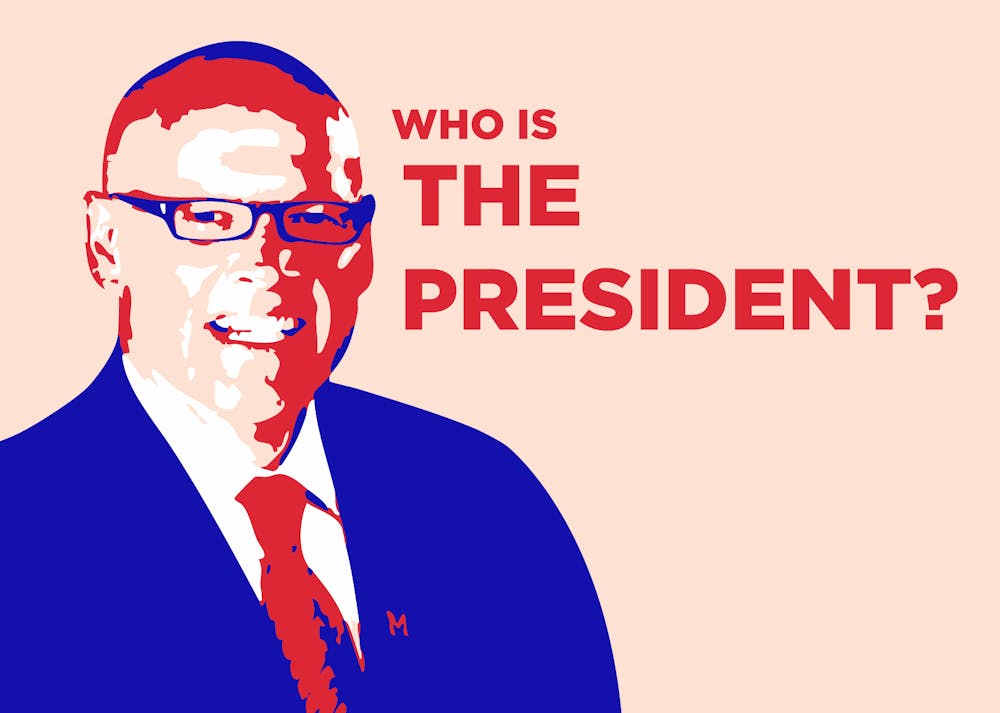
“Leading a university is kind of like overseeing a small city.”
For Miami University President Gregory Crawford, his job doesn’t fit one description. He manages a restaurant business, a hotel, a sports enterprise, a real estate arm, a police force, and, most importantly, a comprehensive educational system.
All of this comes together to create one campus that Crawford said is both “intriguing and challenging” to run – Miami University.
To confront the obstacle of managing all the different parts, in the 10 years he’s been president, Crawford created a system of pillars to ensure he can remain focused. This includes strategic thinking about how to ensure academic excellence and student success, and also how to become uniquely distinctive as a university while balancing liberal arts elements and research competitiveness.
“How do we move and maneuver in this world where there's a lot of technology, and how do we keep the human spirit here is a part of the Miami education?” Crawford said. “... I think that's part one. I think the second piece is certainly the mission element.”
Crawford said recently there’s been a lot of focus on the new solar field and furthering sustainability efforts on campus, as well as ensuring Miami’s commitment to affordability with support from funding such as the Chrissy Taylor last mile scholarship.
Enjoy what you're reading?
Signup for our newsletter
The largest pillar he focuses on is the budget, which he said typically exceeds $800 million annually. This includes building a sustainable budget model for future generations, creating a strong endowment, which over the past nine years he said is more than a billion dollars, and raising money through alumni relations.
He added that the income from the endowment funds Miami’s academic programs – the philanthropy campaign started about a decade ago, has earned roughly $820 million, with $300 million of that going toward scholarships.
Finally, he focuses on building community and culture “to really infuse the spirit of love and honor in our culture and our education based on character and intellect throughout all that we do.”
Maiyah Williams, a junior zoology major, said even though she isn’t quite sure what his position entails, she always sees him active and involved in the community.
“He goes out of his way to do things that other presidents of other universities don’t do,” Williams said. “... [He has] a really strong presence on campus, because he'll go to events, not as a president, but as a person and a member of this community that you can go and talk to and just relate to as a person.”
A couple of misconceptions come with being the president of more than 20,000 students. He is not all-powerful, and he has a boss: the Board of Trustees.
“It's not a top-down organization with full authority of one person,” Crawford said. “My job is largely around consensus building, collaboration, influence and connecting the dots with people in different units across the campus.”
His relationship with the board, a collective body of 17 people, is all about trust and a shared love for the university.
“The board trusts me to make decisions and manage this university and not to micromanage me,” he said, “and then I also trust the board when they give me constructive feedback or constructive criticism, that it's always coming from a good place from their heart.”
Not only does Crawford work with the board, but he also has a president’s executive cabinet of 20 members with whom he collaborates.
Jayne Brownell, the senior vice president for student life, is one of four people on Crawford’s cabinet who predate him.
She said a main part of her job is being a “chief student advocate” where she ensures the student experience, needs and challenges are reflected during the weekly cabinet meetings, trustee meetings, alumni conversations and more.
“[I make] sure students stay the center of the conversation,” Brownell said.
She added that while her expertise is in students and student life, part of her role as a vice president in Crawford’s cabinet is thinking about the needs of Miami as a whole and understanding how the university can work as a cohesive unit.
“We are both advisors for him and the people who are carrying out the vision that he and the board of trustees have,” Brownell said. “So, it really is a two-way street that he is not purely directing us, but we are also advising him.”
Before Crawford came to Miami in 2016, the president’s cabinet had about 10 members; he has since doubled that number.
“President Crawford has grown that group over time because he wants to hear the voices,” Brownell said. “He wants to hear the opinions. He doesn't want it to be eight people [in a] room deciding the course of the university; He wants as many different experts with different perspectives and different views to give him feedback as we move forward, so I think that tells you a lot about him and his kind of leadership.”
Read More
Miami football adapts to NIL era
By Colin McDonald | 2 hours agoAs Miami continues to increase its investment in football, the RedHawks will have to prove that their new approach to NIL can keep them competitive without becoming financially unsustainable in the coming years.

More than a Midwest school: Miami attracts students from across the nation
By Sofie Terlesky | 3 hours agoMiami University brings together students from all different backgrounds. For some, it’s a 45-minute drive from home; for others, it’s a six-hour plane ride. Regardless of the distance, many students come to see Miami as their home away from home.

Finding comfort in food
By August Humphrey | 4 hours agoFood: possibly one of my favorite four-letter words; not just because I love a good meal, but also because of how it can represent people’s identities. Just take a quick look at the TV schedule for the Food Network, where celebrities take us into their personal lives with food. People like Ree Drummond take us behind the scenes and show us what food means to them, and the impact it’s had on their lives. Not only do we need food to live, we need it to thrive.